

Aggravated Intimidation Allegations over Honking and Slowing Down in Front of Another Car in a Road Rage Dispute
핵심 요약
We represented an individual who was accused by another driver of aggravated intimidation using a motor vehicle after a dispute on the road. Video footage confirmed that our client had sounded the horn and slowed down in front of the other vehicle. However, the police found insufficient evidence of an intent to threaten or of an objectively threatening act and issued a decision not to refer the case for prosecution on the ground of no suspicion (insufficient evidence).
The central issue was not whether the honking and slowing down had occurred, but whether the circumstances leading to that conduct and the actual manner of driving showed an intent to threaten, assessed on the basis of objective evidence and the applicable legal principles.
사건 개요
Our client, A, was driving straight through an intersection in Gyeonggi Province. At that intersection, the first lane was a left-turn-only lane, and the second and third lanes were for through traffic. While A was proceeding straight in the second lane, the other vehicle, which should have turned left from the first lane, continued straight and entered A's path. A swerved to avoid a collision and sounded the horn.
A believed it was necessary to confirm whether an accident had occurred even though the vehicles had not actually made contact. A had been receiving treatment after being diagnosed with injuries and a disc condition from a previous traffic accident, and the dashcam in A's vehicle was not working at the time. To confirm with the other driver how the incident had occurred, A used the turn signal and hazard lights, moved in front of the other vehicle, and slowed down gradually to prompt it to stop.
The other driver, however, claimed that A had become angry at the other driver's driving, repeatedly sounded the horn, and slowed down in front of the other vehicle in a threatening manner. A was ultimately accused of aggravated intimidation for allegedly threatening the other driver with a motor vehicle and was questioned by the police.
주요 쟁점
Honking and Slowing Down Captured on Video
A factor that could have weighed against our client was that some of the driving at issue had been captured on the dashcam footage submitted by the other driver and on crime-prevention CCTV. The investigation confirmed that our client had sounded the horn at the other vehicle about four times, had moved in front of the other vehicle and slowed down twice, and had prompted the other driver to stop.
Viewed in isolation, these scenes could have raised suspicion that our client had driven in a threatening manner out of frustration with the other driver.
Requirements for Aggravated Intimidation Using a Motor Vehicle
Article 284 of the Criminal Act provides that a person who threatens another while carrying a dangerous object may be punished by imprisonment for up to seven years or a fine of up to KRW 10 million. Depending on how it is used, a motor vehicle may also qualify as a dangerous object, so blocking another driver's path or braking suddenly with a vehicle may lead to an aggravated intimidation charge.
However, sounding the horn several times or slowing down in front of another vehicle does not, by itself, establish aggravated intimidation. To establish the offense of intimidation, it must be determined whether there was an objective threat of harm capable of causing fear in the other person and whether the driver had an intent to threaten. The Supreme Court has also held that whether intimidation is established must be determined by considering all the circumstances before and after the conduct (Supreme Court en banc Decision 2007Do606, rendered September 28, 2007).
디센트 전략
In responding to the police investigation, Decent Law Firm comprehensively reviewed the lane configuration of the intersection, our client's statements, the dashcam footage, and the crime-prevention CCTV. We demonstrated that aggravated intimidation was difficult to establish, focusing on three issues: the other vehicle's preceding driving, the actual manner in which our client slowed down, and the purpose of prompting the other vehicle to stop.
1. The Other Vehicle's Improper Lane Entry and the Resulting Collision Risk
We first confirmed the actual lane configuration of the intersection. The other vehicle had gone straight from the left-turn-only lane and, in doing so, entered the second lane in which our client was traveling, creating a risk of collision.
Presenting materials showing the road layout and how the vehicles had moved, we explained that our client sounded the horn in response to a sudden collision risk, not to attack the other driver. Our point was that the reason for using the horn needed to be examined before counting how many times it was used.
2. Gradual Deceleration Distinguished from Sudden Braking
It was confirmed that our client moved in front of the other vehicle and slowed down twice. However, we emphasized that our client did not cut in abruptly or brake suddenly to provoke a collision, but slowed down gradually while using the turn signal and hazard lights.
Comparing the manner of driving shown in the video footage with our client's statements, we argued that sudden braking intended to threaten another driver must be distinguished from slowing down to confirm how an incident occurred. Because slowing down or prompting another vehicle to stop is not always justified, we examined in detail how our client actually drove and whether there was any indication that our client deliberately created a risk of collision.
3. The Purpose of Prompting the Other Vehicle to Stop: Confirming What Had Happened
At the time, the dashcam in our client's vehicle was not working, and our client had been receiving treatment for injuries from a previous traffic accident. Explaining these circumstances, we emphasized that our client approached the other vehicle not to cause harm but to confirm whether an accident had occurred and to take any necessary follow-up steps. We also reviewed our client's use of the turn signal and hazard lights, the manner of deceleration, and the fact that the other vehicle kept trying to move on.
In the process, we submitted defense counsel's written opinion and relevant case law, specifically disputing whether our client's conduct satisfied the elements of aggravated intimidation under the Criminal Act. While acknowledging the driving captured on video, we focused on determining, based on objective evidence and legal principles, whether that conduct was intended to threaten the other driver.
결과 및 의의
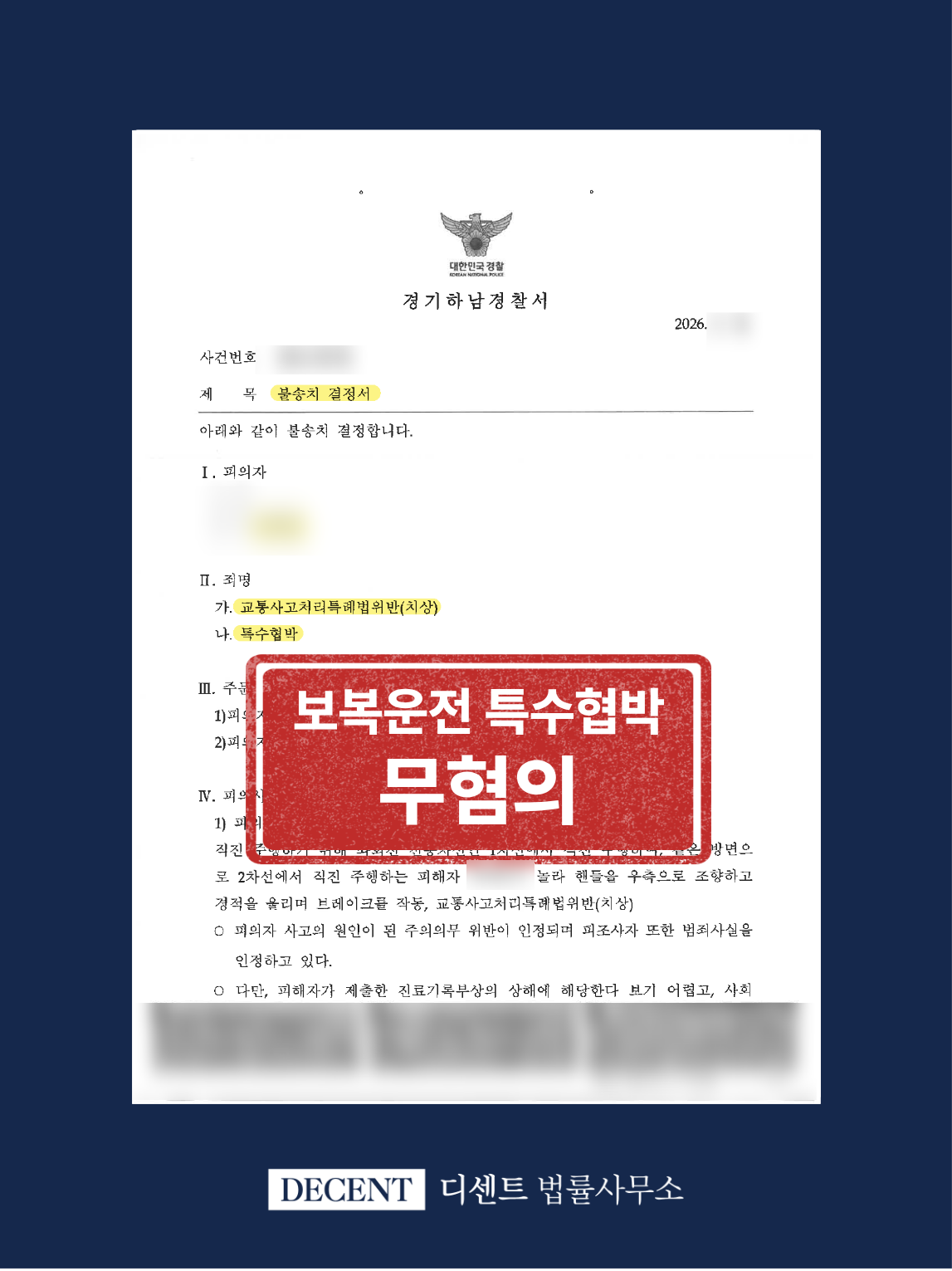
Police Decision Not to Refer the Aggravated Intimidation Case Arising from Alleged Road Rage
Police Non-Referral Decision on the Ground of No Suspicion
The police reviewed not only our client's statements but also the dashcam footage submitted by the other driver and the crime-prevention CCTV. The police acknowledged that our client had sounded the horn and slowed down about twice in front of the other vehicle.
However, the police took into account that our client had turned on the turn signal and proceeded slowly in order to confirm the other driver's conduct that had caused the incident and to take necessary steps. On that basis, the police concluded that it was difficult to find an intent to threaten and that the conduct was objectively insufficient to constitute a threat of harm capable of causing fear, and issued a decision not to refer the aggravated intimidation charge for prosecution (no suspicion, insufficient evidence).
| Key Issue | Police Assessment |
|---|---|
| Horn used about four times | Use of the horn acknowledged as fact |
| Two slowdowns in front of the other vehicle | Slowdowns shown in the video acknowledged as fact |
| Intent to threaten | Difficult to conclude, as the conduct could be seen as an attempt to confirm how the incident occurred |
| Establishment of aggravated intimidation | Insufficient evidence of an objective threat or intent to threaten |
The police did not deny that our client had moved in front of the other vehicle and slowed down. Rather, the police separately assessed whether that driving was intended to threaten the other driver.
Response to the Complainant's Objection
When the complainant subsequently filed an objection, Decent Law Firm re-examined the existing video footage and the grounds for the police non-referral decision, and responded by submitting an additional written opinion of defense counsel setting out the requirements for aggravated intimidation.
Significance of the Case
This case shows that, even where it is confirmed that a driver sounded the horn several times and slowed down in front of another vehicle, those facts alone do not establish aggravated intimidation. In road rage cases, it is necessary to examine not only the other driver's claim of feeling threatened but also the actual circumstances in which the driving took place.
A driver facing police questioning over alleged road rage should review how the risk of collision with the other vehicle first arose, the lane configuration and direction of travel at the scene, the actual manner of driving before and after using the horn and slowing down, whether there was any dangerous driving such as sudden braking or blocking the other vehicle's path, and whether the dashcam and CCTV footage are consistent with the driver's own statements. Even if some unfavorable scenes appear on video, the legal assessment may differ depending on the surrounding circumstances and the purpose of the conduct.
자주 묻는 질문 (FAQ)
Does sounding the horn and slowing down in front of another car constitute aggravated intimidation through road rage?
Honking or slowing down does not, by itself, immediately establish aggravated intimidation. Whether the vehicle was used as a dangerous object, whether there was an objective threat of harm capable of causing fear, and whether there was an intent to threaten are assessed together with the circumstances before and after the conduct. However, dangerous driving such as sudden braking or blocking another vehicle's path may give rise to aggravated intimidation, so the conclusion in this case cannot be generalized to every case.
Is it difficult to avoid punishment if the other driver's dashcam captured unfavorable scenes?
Even if the footage shows honking or slowing down, the assessment may differ depending on the surrounding collision risk, the lane configuration, the manner of deceleration, and the purpose of the conduct. It is important to acknowledge the facts shown in the footage while explaining, with objective materials, whether that conduct amounts to a threat.
What happens if a complainant objects to a police non-referral decision?
If a complainant files a valid objection, the case is referred to a prosecutor for review. The prosecution examines the investigation records and submitted materials to determine whether to indict or take other appropriate action.
Relevant Legislation and Case Law
National Law Information Center: Criminal Act, Article 283
National Law Information Center: Criminal Act, Article 284
National Law Information Center: Criminal Procedure Act, Article 245-7
법률상담 안내
모든 상담은 담당 변호사의 사건 검토를 거쳐 진행됩니다.
사건의 주요 내용을 미리 남겨주시면 보다 구체적인 상담을 받으실 수 있습니다.