

Defendant Representation in Claim for Return of Agreed Payment: Claim Dismissed at Both Trial and Appeal
사건 개요
- Client Information
- Individual / Defendant
- Case Details
The client had previously been involved in the operation of an accessory retail business together with an acquaintance.
However, the business registration and business bank account were both held solely in the name of the opposing party, the plaintiff. The client did not have authority to manage business funds or participate in key business decisions.
The plaintiff later claimed that a partnership agreement, or a civil partnership under Article 703 of the Korean Civil Act, had been formed between the parties based on the fact that the client had participated in certain aspects of store operations.
The plaintiff further argued that a KRW 20 million small business policy loan taken out in the plaintiff’s name had been used for the joint business, and therefore sought KRW 10 million, representing half of the loan amount, plus delay damages from the client.
The court of first instance dismissed the plaintiff’s claim in full. The plaintiff appealed, and the client needed to maintain the favorable outcome at the appellate stage.
디센트 전략
First, whether a partnership agreement under the Korean Civil Act had actually been formed between the plaintiff and the defendant.
Second, even if a partnership were assumed, whether the loan taken out solely in the plaintiff’s name qualified as a partnership debt incurred for the joint business.
Decent Law Firm focused on the following three points in the appeal proceedings.
1. Disputing the Existence of a Legal Partnership
Under Article 703 of the Korean Civil Act, a partnership requires an agreement between two or more parties to make mutual contributions and jointly operate a business.
The Korean Supreme Court has held that merely working toward a common purpose is not sufficient to establish a civil partnership.
In this case, Decent Law Firm emphasized that the business registration and business account were both under the plaintiff’s sole name, and that there was no agreement on capital contributions, role allocation, cost sharing, or profit-and-loss distribution.
2. Emphasizing the Plaintiff’s Burden of Proof Regarding the Loan
If the plaintiff wished to claim that the loan was a partnership debt, the plaintiff had to prove through objective evidence that the loan proceeds were actually used for the joint business.
The plaintiff failed to do so.
Instead, through financial transaction records obtained by the defendant’s side via a court order for financial information disclosure, it was confirmed that part of the loan proceeds had been transferred to the plaintiff’s family member and to a third party unrelated to the business. It was also confirmed that the funds had been used on a monthly basis to pay interest on the plaintiff’s personal debt to a private lending company.
3. Arguing That Settlement Had Already Been Completed
The plaintiff had stated that, at the time the client left the business, the remaining account balance and physical assets had been divided.
If a partnership agreement and joint debt had truly existed, it would have been natural for the plaintiff to request contribution from the client at the time of departure or shortly thereafter.
However, the plaintiff made no such request for approximately three years.
Decent Law Firm argued that this supported the conclusion that the parties had already completed settlement at the time of the client’s departure, and that the loan was recognized by the plaintiff as the plaintiff’s own personal debt.
결과 및 의의
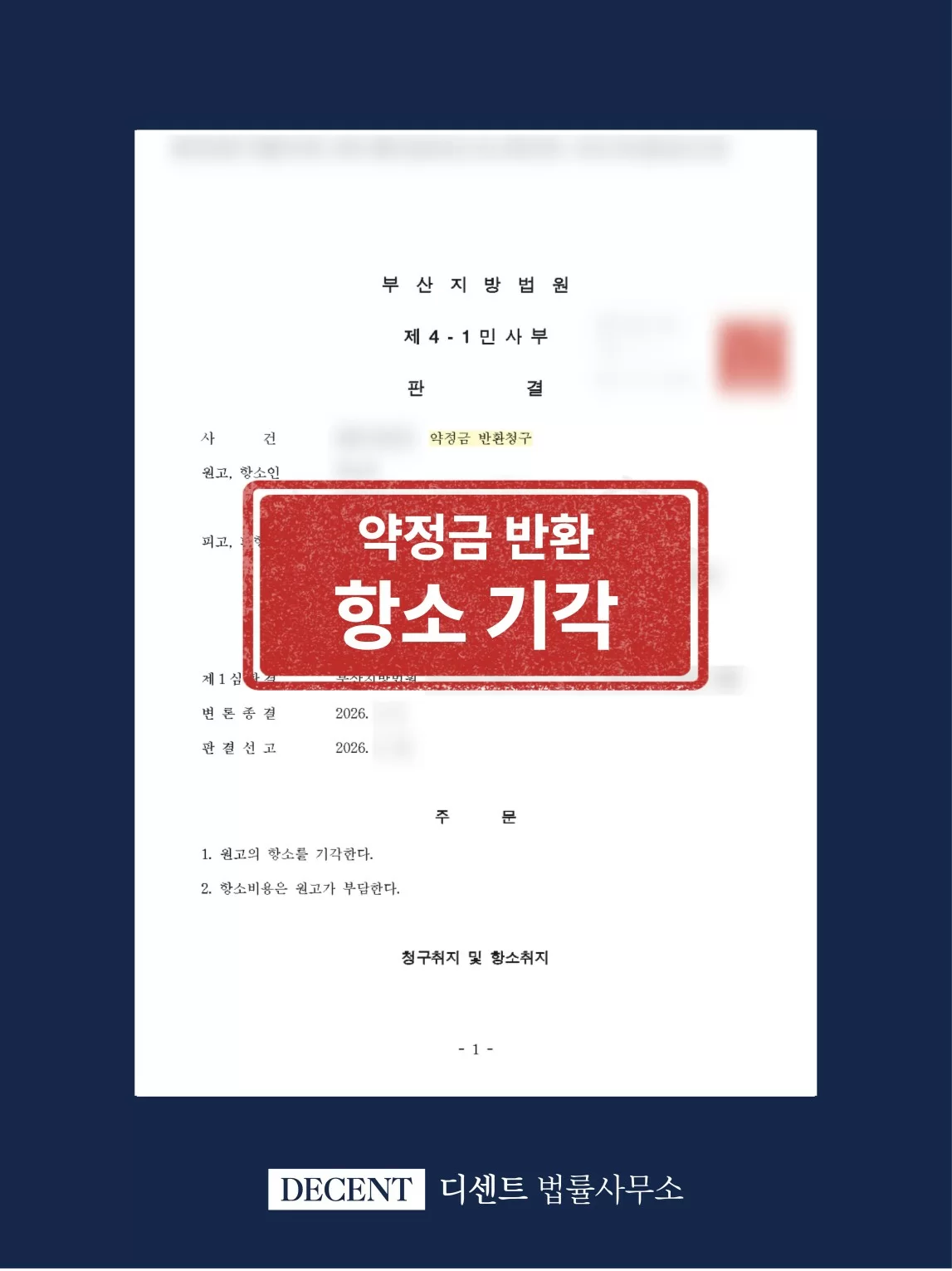
The appellate court dismissed the plaintiff’s appeal and upheld the first-instance judgment dismissing the plaintiff’s claim.
The appellate court reviewed the plaintiff’s KakaoTalk messages, social media posts, and other submitted evidence, but found it difficult to conclude that the parties had reached a mutual agreement to jointly operate the business.
The court placed particular importance on the absence of any agreement regarding the method of joint operation, role allocation, capital contribution obligations, or profit-and-loss distribution.
The court also noted that the business registration was under the plaintiff’s sole name, that there was no evidence showing that the plaintiff had discussed the need for the loan or the business’s financial situation with the client, and that the plaintiff’s account records included multiple transactions that appeared to be personal expenditures.
As a result, the first-instance judgment dismissing the plaintiff’s claim was maintained on appeal, leading to a successful outcome for the defendant.
법률상담 안내
모든 상담은 담당 변호사의 사건 검토를 거쳐 진행됩니다.
사건의 주요 내용을 미리 남겨주시면 보다 구체적인 상담을 받으실 수 있습니다.