

Crypto
Legal Advisory on an Overseas Incorporation Structure for a Virtual Asset Auto-Trading Service
사건 개요
- Client Information
- Corporate / Business Entity
- Case Details
-
DECENT Law Firm was retained by a startup operating a subscription-based auto-trading software service that connects to virtual asset exchange APIs and executes algorithm-based trading strategies.
The client had already incorporated a Korean entity and was preparing to expand its service to non-Korean users. Before launching the service more broadly overseas, the client sought legal advice on where to establish an overseas entity and how to structure transactions between the Korean entity and the foreign entity.
디센트 전략
1. Selecting the Appropriate Jurisdiction for the Overseas Entity
DECENT reviewed Hong Kong and Singapore as potential jurisdictions, comparing their virtual asset regulatory frameworks, potential tax treatment for offshore income, banking account opening practices, and overall regulatory stability.
Hong Kong presented advantages from a short-term tax efficiency perspective, as offshore income may be exempt from profits tax subject to review by the Inland Revenue Department. Singapore, by contrast, does not provide an equivalent offshore income exemption regime. However, Singapore offered stronger regulatory predictability and long-term stability under the independent regulatory framework led by the Monetary Authority of Singapore.
Based on these differences, DECENT assessed not only the immediate tax impact but also the client’s future fundraising plans, operational structure, and regulatory exposure.
2. Reviewing the Revenue and Service Fee Structure Between the Korean and Overseas Entities
The client’s business structure required careful review because the Korean entity was responsible for algorithm development and service operation, while the overseas entity would serve as the contracting and payment-facing entity for non-Korean users.
DECENT analyzed whether a substantial portion of the overseas entity’s revenue could be allocated to the Korean entity as service fees, based on the functions, assets, and risks assumed by each entity under OECD transfer pricing principles.
In addition, DECENT designed a flexible transition structure in anticipation of potential regulatory changes in Hong Kong. This included considering Singapore law as the governing law for subscription agreements, SIAC arbitration as the dispute resolution mechanism, and contractual provisions allowing the operating entity to be changed or succeeded if needed.
DECENT reviewed Hong Kong and Singapore as potential jurisdictions, comparing their virtual asset regulatory frameworks, potential tax treatment for offshore income, banking account opening practices, and overall regulatory stability.
Hong Kong presented advantages from a short-term tax efficiency perspective, as offshore income may be exempt from profits tax subject to review by the Inland Revenue Department. Singapore, by contrast, does not provide an equivalent offshore income exemption regime. However, Singapore offered stronger regulatory predictability and long-term stability under the independent regulatory framework led by the Monetary Authority of Singapore.
Based on these differences, DECENT assessed not only the immediate tax impact but also the client’s future fundraising plans, operational structure, and regulatory exposure.
2. Reviewing the Revenue and Service Fee Structure Between the Korean and Overseas Entities
The client’s business structure required careful review because the Korean entity was responsible for algorithm development and service operation, while the overseas entity would serve as the contracting and payment-facing entity for non-Korean users.
DECENT analyzed whether a substantial portion of the overseas entity’s revenue could be allocated to the Korean entity as service fees, based on the functions, assets, and risks assumed by each entity under OECD transfer pricing principles.
In addition, DECENT designed a flexible transition structure in anticipation of potential regulatory changes in Hong Kong. This included considering Singapore law as the governing law for subscription agreements, SIAC arbitration as the dispute resolution mechanism, and contractual provisions allowing the operating entity to be changed or succeeded if needed.
결과 및 의의
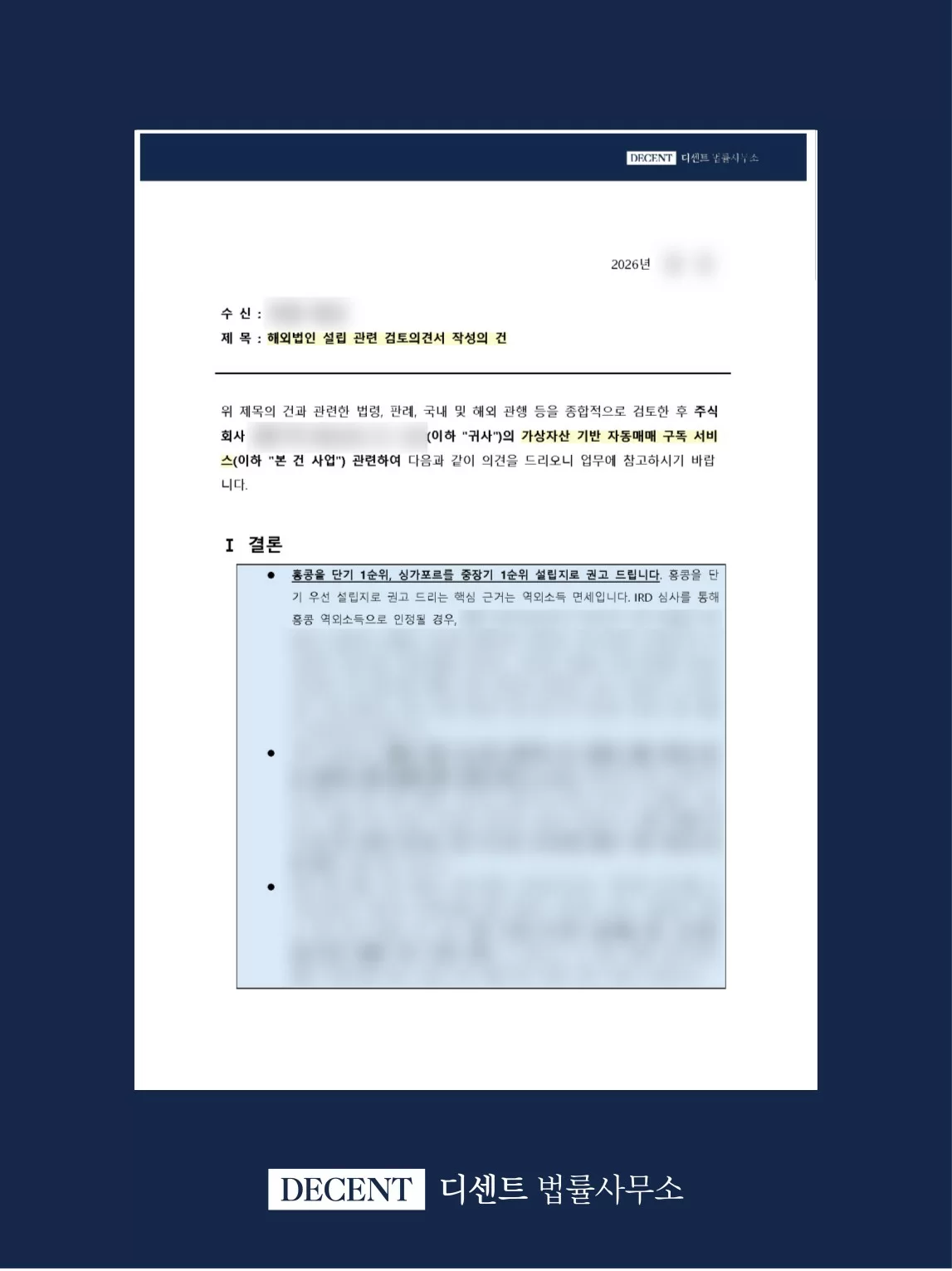
"Provision of a Legal Review Memorandum"
DECENT issued a legal review memorandum recommending Hong Kong as the preferred short-term jurisdiction and Singapore as the preferred medium- to long-term jurisdiction.
The proposed structure was designed to secure short-term tax efficiency through a Hong Kong entity while preserving flexibility to transition to a Singapore-based structure if regulatory conditions changed. DECENT also advised on a contractual framework that would allow the client to manage future operational changes without disrupting existing user relationships.
This case demonstrates that overseas incorporation for virtual asset businesses should not be approached as a simple company formation matter. For businesses involving API-based trading, subscription software, or virtual asset-related services, the incorporation jurisdiction, tax structure, regulatory classification, and intercompany contractual arrangements must be reviewed together from the outset.
DECENT issued a legal review memorandum recommending Hong Kong as the preferred short-term jurisdiction and Singapore as the preferred medium- to long-term jurisdiction.
The proposed structure was designed to secure short-term tax efficiency through a Hong Kong entity while preserving flexibility to transition to a Singapore-based structure if regulatory conditions changed. DECENT also advised on a contractual framework that would allow the client to manage future operational changes without disrupting existing user relationships.
This case demonstrates that overseas incorporation for virtual asset businesses should not be approached as a simple company formation matter. For businesses involving API-based trading, subscription software, or virtual asset-related services, the incorporation jurisdiction, tax structure, regulatory classification, and intercompany contractual arrangements must be reviewed together from the outset.
법률상담 안내
모든 상담은 담당 변호사의 사건 검토를 거쳐 진행됩니다.
사건의 주요 내용을 미리 남겨주시면 보다 구체적인 상담을 받으실 수 있습니다.


