

Crypto Fraud Charges: Headquarters' Instructions and the Use of Investment Funds
핵심 요약
A staff member on the Korea team of an overseas blockchain project was indicted for fraud for allegedly obtaining investment funds in the KRW 30 million range. By explaining the headquarters' instruction and reporting structure, the token allocation records, how the investment funds were used, and the client's subsequent requests for token distribution, DECENT Law Firm obtained an acquittal at first instance.
사건 개요
- Client Information
- Individual / Defendant
- Case Details
The client worked on the Korea team of an overseas blockchain project and was responsible for marketing and business development in Korea, community operations, and investor management.
When a Korean investor inquired about buying tokens, the client reported the matter to headquarters, guided the investor through the investment process with headquarters' approval and instructions, and shared the investor's information and token allocation details with headquarters.
The alleged victim in this case also asked through the Korean community whether tokens could be purchased and, following the client's guidance, sent Ethereum worth in the KRW 30 million range to a designated wallet.
When delivery of the tokens purchased by the alleged victim was delayed, prosecutors indicted the client for fraud, alleging that he had deceived the victim and received the investment without any intention or ability to deliver the tokens properly from the outset.
The client maintained that he had not personally misappropriated the investment but had performed Korea team duties under headquarters' instructions. DECENT Law Firm defended the criminal trial to prove this work structure and how the funds were used with objective evidence.
주요 쟁점
1. Whether the Client Recruited Investors Independently
The client was responsible for marketing, business development, community management, and investor management on the Korea team of an overseas blockchain project.
The alleged victim also inquired about buying tokens through the Korean community, and the client proceeded with the investment process after reporting to headquarters and obtaining its approval.
A key issue was therefore whether the client personally recruited investors independently of headquarters, or handled investor relations and token sales within headquarters' business system.
2. Whether the Use of the Investment Constituted Personal Misappropriation
Prosecutors took issue with the fact that the virtual assets paid by the alleged victim had been used for the client's salary and other expenses.
However, at the time, headquarters had been unable to pay the Korea team's salaries and operating costs on time, and there was evidence that the head of headquarters had instructed that token sale proceeds received from Korean investors be used for the Korea team's operating costs and salaries.
It was therefore necessary to distinguish whether the funds had been spent arbitrarily by the client for personal purposes or disbursed for business purposes under headquarters' instructions.
3. Whether There Was No Intention to Deliver the Tokens from the Outset
In assessing the fraud charge, the key question was not only that the tokens were not delivered after the investment, but whether there was an intention to deceive the counterparty and obtain the money at the time the investment was received.
The client recorded the investor's payment in the investor list shared with headquarters and proceeded with the token allocation process, and continued to ask headquarters for distribution after delivery was delayed.
There was also evidence that the client directly gave the alleged victim some of the tokens he held, so whether this subsequent conduct was compatible with an intent to defraud became a key issue.
디센트 전략
1. Proving an Investment Process Based on Headquarters' Approval and Instructions
DECENT Law Firm first rebutted the premise that the client had recruited investors independently of headquarters.
By analyzing messages with the head of headquarters, the process of recruiting Korean investors, KYC procedures, and investor management records, we showed in detail that recruiting Korean investors and allocating tokens were tasks carried out under headquarters' approval and reporting system.
We also showed that the wallet to which the alleged victim sent the virtual assets was one used for Korean investors, and that other investors had invested through the same structure and actually received their tokens.
2. Showing a Normal Token Allocation Process Through Google Sheets and Other Records
After confirming the alleged victim's payment, the client asked a Korea team member to enter the number of tokens to be allocated to the alleged victim in a Google spreadsheet shared with headquarters.
By combining the investor list, token allocation records, and messages with headquarters, DECENT Law Firm showed that the alleged victim's investment had been reflected in the normal internal management process.
This was important evidence contradicting the claim that the client had concealed the alleged victim's existence after receiving the investment or had taken the funds without any intention of delivering tokens.
3. Explaining How the Investment Was Used Under Headquarters' Instructions
When headquarters was unable to pay the Korea team's salaries and operating costs, the head of headquarters instructed that token sale proceeds received from Korean investors be used to run the Korea team.
Through messages between the head of headquarters and the client and expense records, DECENT Law Firm explained in detail that the investment was not used for the client's personal misappropriation but for the Korea team's salaries and operating costs under headquarters' instructions.
The court also took into account, in reaching its acquittal, that this use of funds appeared to have been made on the instructions of the head of headquarters.
4. Showing Continued Requests for Token Delivery and Subsequent Conduct
When token allocation to Korean investors was delayed, the client repeatedly asked the head of headquarters to deliver the tokens.
He asked for the exchange listing to be postponed, noting that problems could arise if the listing took place before investors received their tokens, and continued to request token distribution to investors, including the alleged victim.
The client also directly gave the alleged victim some of the tokens he held.
Through these materials, DECENT Law Firm showed the court that the client's actual conduct was inconsistent with the claim that he intended to misappropriate the investment from the outset.
결과 및 의의
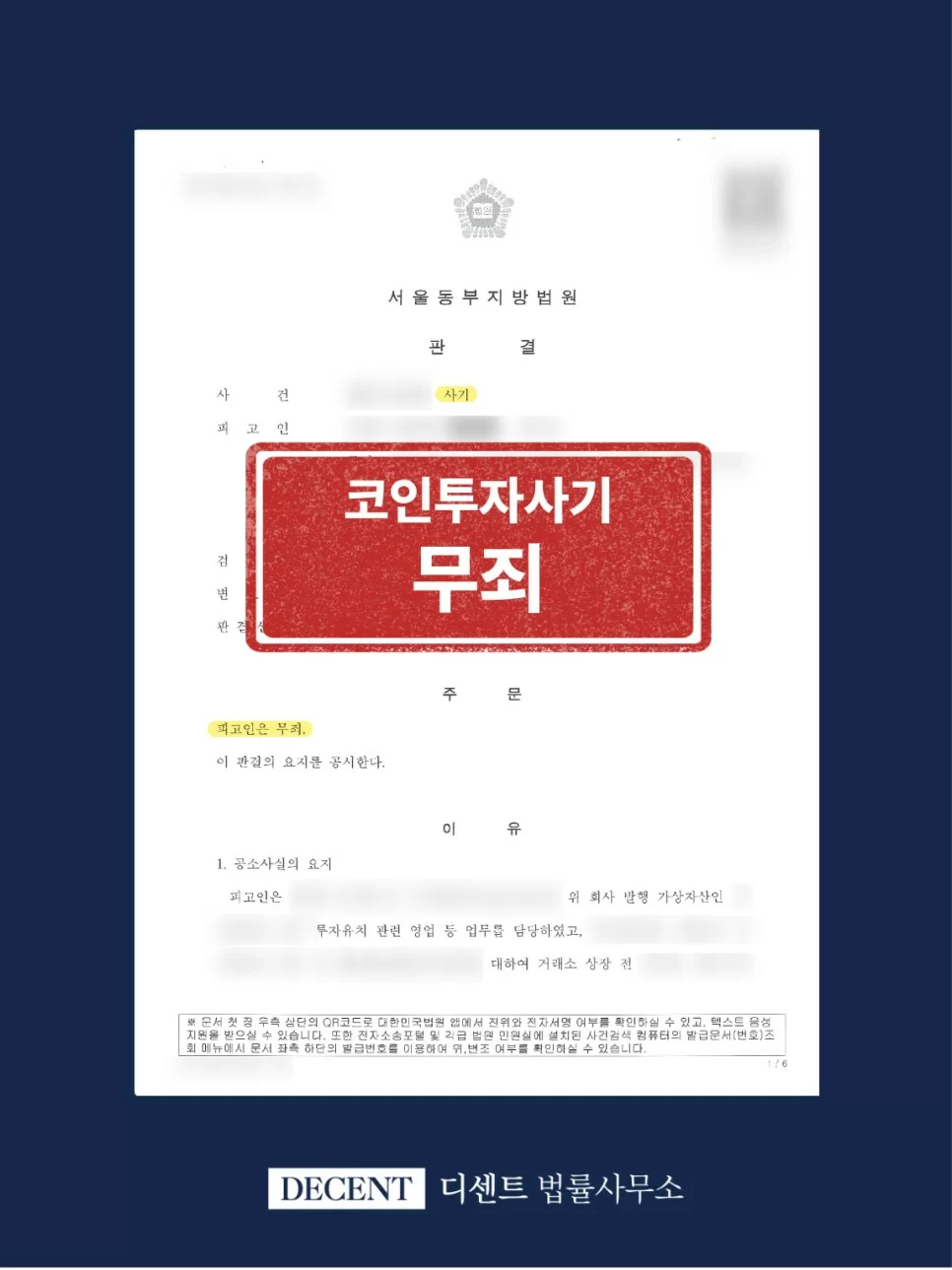
Acquittal at First Instance
The court held that the evidence submitted by the prosecution was insufficient to prove beyond a reasonable doubt that the client had deceived the alleged victim or intended to misappropriate the investment, and acquitted him of the fraud charge.
1. Recognition of a Work Structure Based on Headquarters' Approval and Instructions
The court confirmed that a separate investment process and wallet had been operated for Korean investors, and that other Korean investors had sent investments to the same wallet and received tokens.
The court also took into account that the alleged victim's investment information had been reflected in records shared with headquarters, and that the use of the investment for the Korea team's operating costs and salaries appeared to have been made on the instructions of the head of headquarters.
2. Post-Investment Conduct Inconsistent with an Intent to Defraud
The client had the number of tokens to be given to the alleged victim reflected in headquarters' management records and continued to request distribution from headquarters after delivery was delayed.
Considering that the client had demanded that tokens be given to Korean investors, including the alleged victim, and had even directly given some of his own tokens, the court held that it was difficult to conclude that he had deceived the alleged victim and misappropriated the investment from the outset.
자주 묻는 질문 (FAQ)
Q1. Is it automatically investment fraud if tokens are not delivered by the promised date?
Whether fraud is established cannot be determined uniformly based only on the fact that token delivery was delayed or the promised project did not proceed as planned.
The specific facts at the time must be examined together, including what was explained when the investment was received, whether there was an actual intention and process to deliver tokens, and how the investment was managed and used.
In this case as well, the court acquitted the client after considering not only the fact that the tokens were not delivered on time, but also headquarters' investment structure, the token allocation process, and the client's conduct after the investment.
Q2. Is fraud established if investment funds are used for company operating costs or salaries?
The use of funds for operating costs alone does not determine the outcome. It is necessary to confirm who used the funds and under what authority and instructions.
In this case, there was evidence that the client did not spend the investment arbitrarily for personal purposes but used it for the Korea team's operating costs and salaries on the instructions of the head of headquarters, and the court took this into account.
Q3. What materials can show that I worked under the instructions of an overseas headquarters?
It is important to review not only messages exchanged with headquarters but also internal records showing how the work was actually handled.
In this case, we explained the client's scope of work and headquarters' instruction and reporting structure by combining messages with the head of headquarters, the investor list and Google spreadsheet, token allocation records, and statements from Korea team members.
법률상담 안내
모든 상담은 담당 변호사의 사건 검토를 거쳐 진행됩니다.
사건의 주요 내용을 미리 남겨주시면 보다 구체적인 상담을 받으실 수 있습니다.
담당 변호사
대한변호사협회 등록 변호사가
직접 수행 · 검토한 실제 업무사례입니다.