

Accessory to Voice Phishing Allegations in a USDT OTC Trade
핵심 요약
The client was investigated as an accessory to voice phishing after receiving approximately KRW 11 million in cash and transferring Tether (USDT). Based on the circumstances of the trade and the chat records, DECENT Law Firm disputed the client's awareness of the crime and intent to aid it, and obtained a non-referral decision (no charge) due to insufficient evidence.
사건 개요
- Client Information
- Individual / Suspect
- Case Details
Through a person-to-person over-the-counter (OTC) virtual asset trade, the client received approximately KRW 11 million in cash and transferred the corresponding amount of USDT. At the time, the client understood that the counterparty wanted to buy virtual assets for themselves and proceeded with the trade.
The counterparty was later identified as a person connected to a voice phishing crime, and the client also came under investigation. Investigators suspected that the client had helped a criminal organization move funds by receiving voice phishing proceeds in cash and converting them into virtual assets.
The charge was aiding a violation of the Special Act on the Prevention of Loss Caused by Telecommunications-Based Financial Fraud and Refund for Loss. The client admitted that he had received the cash and delivered the USDT, but maintained that he did not know the funds were connected to voice phishing.
주요 쟁점
01. Distinguishing the Fact of the Trade from Awareness of the Crime
There was no dispute that the client had received cash and transferred USDT. The key question was therefore not whether the trade occurred, but whether the client knew at the time that the counterparty was involved in a crime and whether he was aware that he was facilitating voice phishing.
02. Specific Circumstances Showing the Trade Was Perceived as Legitimate
It was necessary to examine how the client came to know the counterparty, the verification steps before the trade, and the content of their conversations to confirm what explanation the client received before trading. The fact that the counterparty was connected to a crime had to be considered separately from whether the client was aware of it.
03. Objective Evidence of Intent to Aid
We examined whether objective materials showed prior collusion with or instructions from a criminal organization, or that the client traded knowing the funds were criminal proceeds. The issue was whether awareness of the crime could be inferred solely from the outward fact of receiving cash and transferring virtual assets.
디센트 전략
01. Organizing the Circumstances of the Trade and the Relationship with the Counterparty
DECENT Law Firm reviewed the process from how the client met the counterparty to receiving the cash and transferring the USDT. In defense counsel's opinions, we set out the circumstances in which the client perceived the counterparty as an ordinary virtual asset buyer and the absence of any indication of prior collusion with or participation in the criminal organization.
02. Explanation Based on Pre-Trade Verification and Chat Records
During the trade, the client tried to confirm the counterparty's identity and purpose for buying the coins. DECENT reviewed the chat records from that time to substantiate the argument that the client had tried to avoid trades involving illicit funds.
On this basis, we explained that the client perceived the transaction as an ordinary person-to-person OTC trade and did not intend to exchange criminal proceeds.
03. Three Opinions Focused on the Lack of Objective Evidence
DECENT emphasized that the fact of receiving cash and transferring USDT must be assessed separately from knowingly aiding voice phishing. We focused on whether the client knew of the counterparty's involvement with a criminal organization and whether there was any basis to conclude that he traded to move criminal funds.
We responded by submitting a total of three defense counsel's opinions to the investigators, setting out the circumstances of the trade, the related materials, and the issues concerning intent to aid.
결과 및 의의
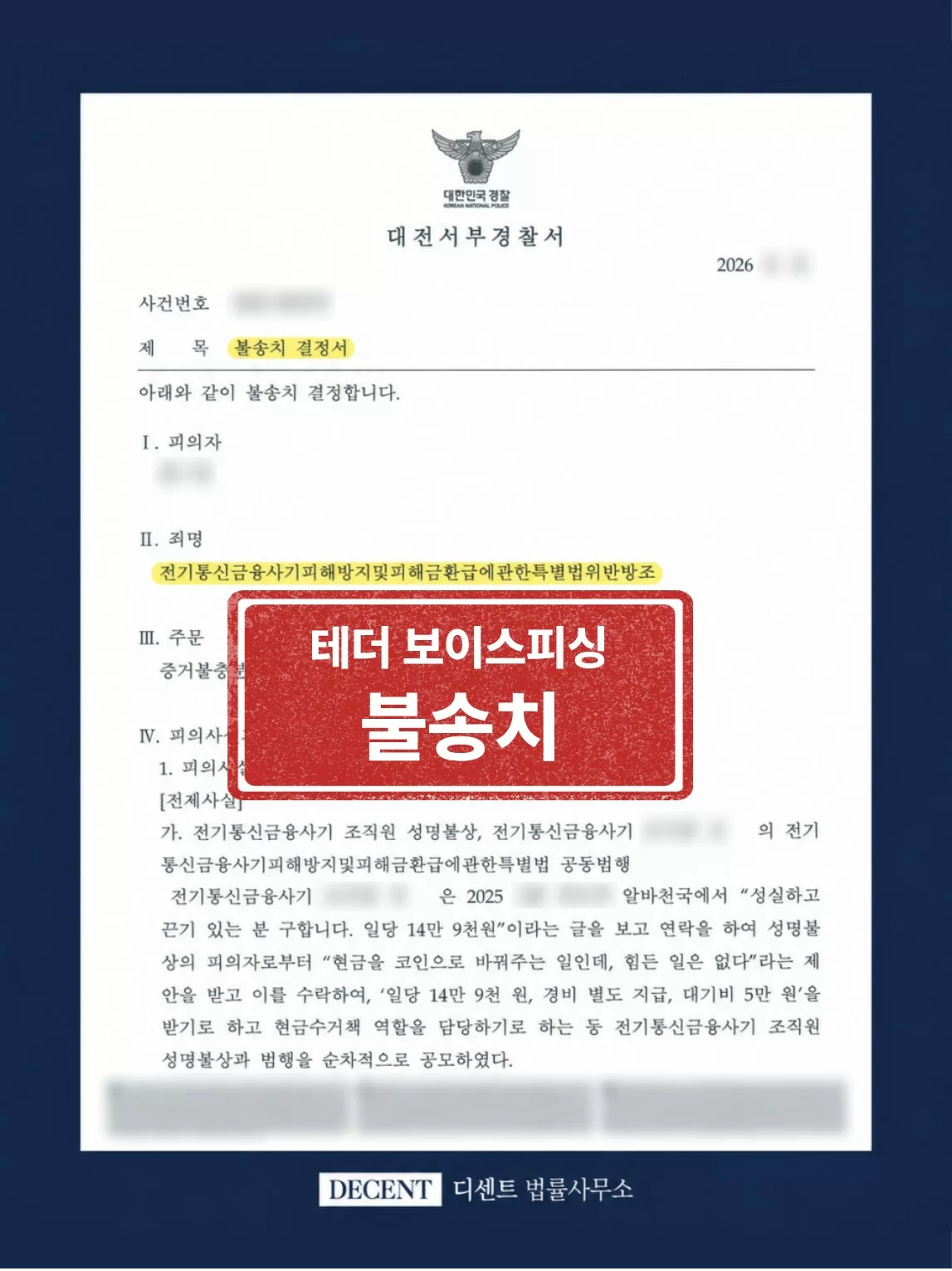
On August 13, 2026, the Daejeon Seobu Police Station issued a non-referral decision (no charge) on the grounds of insufficient evidence.
While acknowledging that the client had received cash and transferred USDT, the police found that there was insufficient objective evidence that the client had participated in voice phishing or traded for the purpose of money laundering.
The police also found no chat records or transaction records indicating that the client knew of the counterparty's involvement with a criminal organization. As a result, a non-referral decision was issued because the evidence was insufficient to establish intent to aid.
Importance of Materials on the Circumstances of the Trade and Awareness of the Crime
This case shows that even when an exchange of cash for virtual assets is confirmed, the trader's awareness and scope of involvement at the time must be examined with concrete evidence. A trader's criminal liability may vary depending on the content of conversations, the method and frequency of trading, and any warning signs at the time.
If you are contacted by investigators regarding an OTC virtual asset trade, you should preserve trade records such as chats with the counterparty, the flow of funds, wallet addresses, and transfer history, and confirm the actual allegations.
자주 묻는 질문 (FAQ)
Q1. Does receiving cash and transferring USDT make me an accessory to voice phishing?
The trade alone does not establish the offense of aiding. Whether there was an act facilitating the crime, together with awareness of the crime and intent to aid, must be examined. It is not necessary to know every detail of the crime, and dolus eventualis or foreseeability may also be considered.
Q2. Can I receive a no-charge decision if I say I did not know the counterparty was involved in voice phishing?
A statement that you did not know does not by itself determine the outcome. Your awareness at the time is assessed based on objective materials such as your relationship with the counterparty, conversations before and after the trade, verification steps, the trading method, and the flow of funds.
Q3. What should I prepare if I am questioned by the police about a crypto trade?
It is important to preserve chats with the counterparty, the trade amount and time, how the cash was received, wallet addresses and transaction IDs (TXIDs), and counterparty verification materials. Organize the actual trading process separately from what you knew at the time, and confirm the specific allegations raised by investigators.
Related case law: Supreme Court Decision 2020Do12563 (October 27, 2022) — the general legal principles on intent to aid set out in a case of aiding a violation of the Real Name Financial Transactions Act.
법률상담 안내
모든 상담은 담당 변호사의 사건 검토를 거쳐 진행됩니다.
사건의 주요 내용을 미리 남겨주시면 보다 구체적인 상담을 받으실 수 있습니다.
담당 변호사
대한변호사협회 등록 변호사가
직접 수행 · 검토한 실제 업무사례입니다.