

Six-Month Prison Sentence for Fraud Imposed While Overseas and the Lawfulness of Service by Public Notice
핵심 요약
The client, who was running a business in the United States, missed the deadline to appeal a first-instance judgment imposing a six-month prison sentence for fraud because he was unaware that his criminal trial in Korea had proceeded and that a judgment had been rendered. DECENT Law Firm reviewed the materials for locating the client, the possibility of service abroad, and the service-by-public-notice procedure, and filed a petition for restoration of the right to appeal. The court found the service by public notice unlawful and recognized that the client was not responsible for missing the deadline, and granted restoration of the right to appeal.
사건 개요
- Client Information
- Individual / Petitioner
- Case Details
The client, a U.S. national, left for the United States after being indicted for fraud in Korea and was running a business there. The criminal trial in Korea continued after his departure, but information on the progress of the trial, such as hearing dates, was not properly delivered to him.
The first-instance court sentenced the client to six months in prison for fraud without his appearance. Unaware of the judgment, the client missed the appeal deadline, and after belatedly learning of the judgment, he asked DECENT Law Firm to respond.
The key question in this proceeding was not whether the client had committed fraud, but whether he had missed the appeal deadline for reasons for which he could not be held responsible.
주요 쟁점
01. Adequacy of Efforts to Locate the Client Before Service by Public Notice
The case record contained information that could have been used to locate the client, such as his family's contact details. The issue was whether sufficient attempts had been made to locate him using these materials and whether the requirements for service by public notice had been met.
02. Records of Residence Abroad and the Possibility of Service Abroad
Materials concerning the client's departure from Korea and his address in the United States had also been submitted to the record. Residence abroad alone does not justify service by public notice, so it was necessary to examine whether service could have been effected by other means.
03. Responsibility for Missing the Appeal Deadline and Requirements for Restoration
Failure to appear at trial or belated awareness of a judgment does not automatically lead to restoration of the right to appeal. The service process, the circumstances in which the client could have learned of the proceedings, and the reasons for missing the deadline had to be explained in concrete terms.
디센트 전략
01. Comparing the Circumstances of Departure with the Service Records
DECENT Law Firm organized the circumstances of the client's departure and life abroad alongside the progress of the trial in Korea, and reviewed how the court documents had been served. We pointed out that service by public notice had proceeded without sufficient efforts to locate the client, even though his family's contact details and materials on his U.S. address were in the record.
02. Presenting the Legal Principles on the Lawfulness of Service by Public Notice
We disputed whether the court had sufficiently examined locating the client through his contacts in Korea and the possibility of service abroad. Based on Article 63 of the Criminal Procedure Act and related case law, we presented the procedural defects of service by public notice carried out without reviewing the location information available in the record.
03. Concrete Explanation of Reasons Beyond the Client's Responsibility
Through the petition for restoration of the right to appeal and a defense counsel's opinion, we explained that the client had not been informed of the progress of the trial or the rendering of the judgment. By connecting the unlawfulness of the service by public notice with the reasons the appeal deadline was missed, we showed that the lapse of the deadline could not be attributed to the client.
결과 및 의의
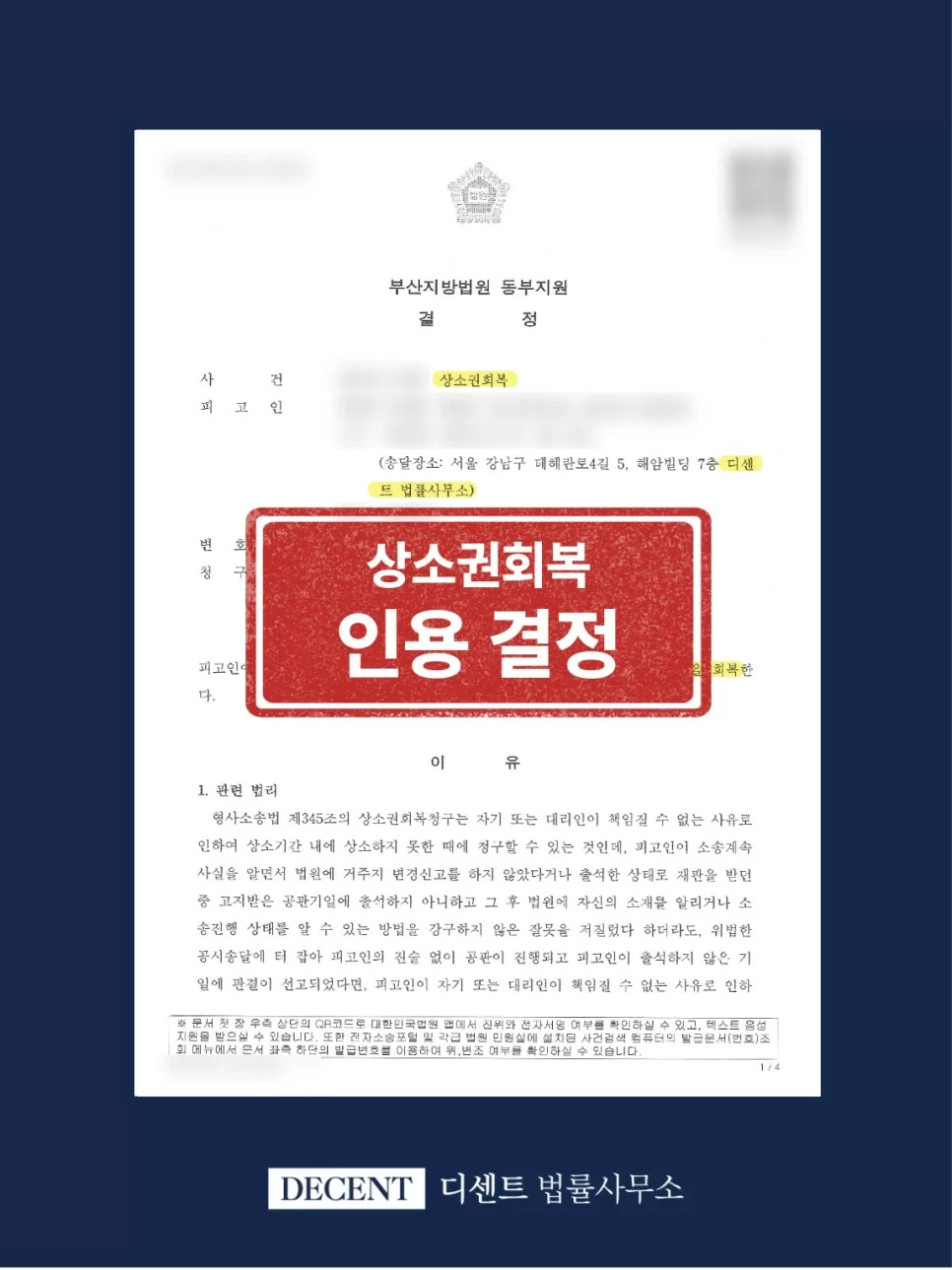
The court granted the petition for restoration of the right to appeal. Having examined the fact that the trial had proceeded by service by public notice without taking sufficient necessary measures despite the existence of location information, such as the family's contact details, and materials on the client's residence abroad, the court held that the service by public notice did not meet the statutory requirements and was unlawful.
Accordingly, the court recognized that the client had missed the appeal deadline for reasons for which he could not be held responsible, and the client regained the opportunity to contest the first-instance judgment on appeal.
Scope of the Decision Restoring the Right to Appeal
Granting restoration of the right to appeal does not mean an acquittal or the cancellation of the prison sentence. Criminal liability and sentencing will be determined separately in the appellate proceedings. The significance of this case lies in restoring the opportunity to appeal by examining the actual service records and efforts to locate the client in detail, rather than relying on the fact of residence abroad itself.
자주 묻는 질문 (FAQ)
Q1. Is restoration of the right to appeal granted simply because I was staying overseas?
Staying overseas alone does not lead to restoration. Whether service of court documents was lawful, whether you could have known about the proceedings, and whether you or your representative were responsible for missing the appeal deadline must be reviewed together.
Q2. By when and how must a petition for restoration of the right to appeal be filed?
Under Articles 345 and 346 of the Criminal Procedure Act, the petition must be filed in writing with the court that rendered the original judgment within a period equal to the appeal period, starting from the date the cause for which you were not responsible ceased. You must explain that cause and file the appeal at the same time as the petition. Because the point at which the cause ceased may be disputed, it is necessary to secure materials on how and when you learned of the judgment.
Q3. If I learned of a judgment belatedly, which materials should I check first?
You should review the judgment, service records such as notices of hearing dates, the decision ordering service by public notice and the related location materials, immigration and overseas residence records, and materials showing how you learned of the judgment. Because the filing period is short, records should be secured and the deadline reviewed promptly.
Related laws: Criminal Procedure Act Articles 63, 345, and 346 · Related case law: Supreme Court Decision 2014Mo1557 (October 16, 2014)
법률상담 안내
모든 상담은 담당 변호사의 사건 검토를 거쳐 진행됩니다.
사건의 주요 내용을 미리 남겨주시면 보다 구체적인 상담을 받으실 수 있습니다.