

No-Charge Decision in a CEO’s Business Embezzlement Case
사건 개요
- Client Information
- Individual / Suspect
- Case Details
-
Our client took over the management of a cosmetics company originally founded by his father and served as its CEO.
As the company’s financial condition deteriorated, he made every effort to keep the business alive. He provided his personal real estate as collateral for the company’s obligations and transferred his own funds directly into the company’s bank account.
Despite these efforts, the company eventually had to close down. Shortly afterward, former employees filed a criminal complaint against the client for alleged business embezzlement.
The complainants alleged that the client had misused company funds for entertainment expenses, rent for a high-end apartment, vehicle lease payments, personal insurance premiums, and transfers to his personal account. The alleged amount of embezzlement was approximately KRW 450 million.Feeling that the accusations were unfair, the client sought assistance from DECENT Law Firm.
디센트 전략
The key issue is whether the accused had an intent of unlawful acquisition. The Korean Supreme Court has held that this intent refers to the intention of a person entrusted with another’s property to dispose of that property as if it were their own, in violation of the purpose of entrustment, for the benefit of themselves or a third party. See, for example, Supreme Court Decision 2002Do745, rendered on July 12, 2002.
DECENT Law Firm focused on presenting a structured defense based on objective evidence and legal reasoning, rather than offering simple explanations.
▪️Proof of Personal Assets Contributed to the Company
Immediately after becoming CEO, the client created a mortgage worth approximately KRW 700 million over his personal real estate for the benefit of the company. When the company was unable to repay the obligation, the property was ultimately sold through auction.
DECENT also proved, through bank transaction records, that the client had transferred approximately KRW 470 million from his personal account to the company over a period of about two years.
These facts were important because they showed that the client was not someone who had simply taken money from the company. On the contrary, he had personally borne substantial financial burdens to support it.
▪️Entertainment Expenses
The disputed entertainment expenses were incurred for business purposes. DECENT submitted materials showing that company employees and overseas buyers were present at the relevant meetings, and that the client had not visited the establishments alone for personal reasons.
▪️Housing Expenses
The high-end apartment was not rented for the client’s personal residence. It was leased under the company’s name as accommodation for overseas buyers who frequently visited Korea.
DECENT also submitted evidence that the company had filed a trademark application in China, supporting the fact that the company was actively pursuing overseas business opportunities.
▪️Vehicle Expenses
The leased luxury vehicle was used for the client’s duties as CEO. DECENT argued that the fact that a vehicle is expensive does not, by itself, establish an intent to embezzle company funds.
▪️Transfers to the Personal Account
The transfers to the client’s personal account were short-term borrowings made at a time when the company was unable to pay his salary. DECENT proved that the client had instructed the company to record the amounts as borrowings in the accounting records.
DECENT also emphasized that the company was a family-owned business in which the client, his mother, and his sibling held all shares. This corporate structure was relevant in assessing whether the client had an intent of unlawful acquisition.
결과 및 의의
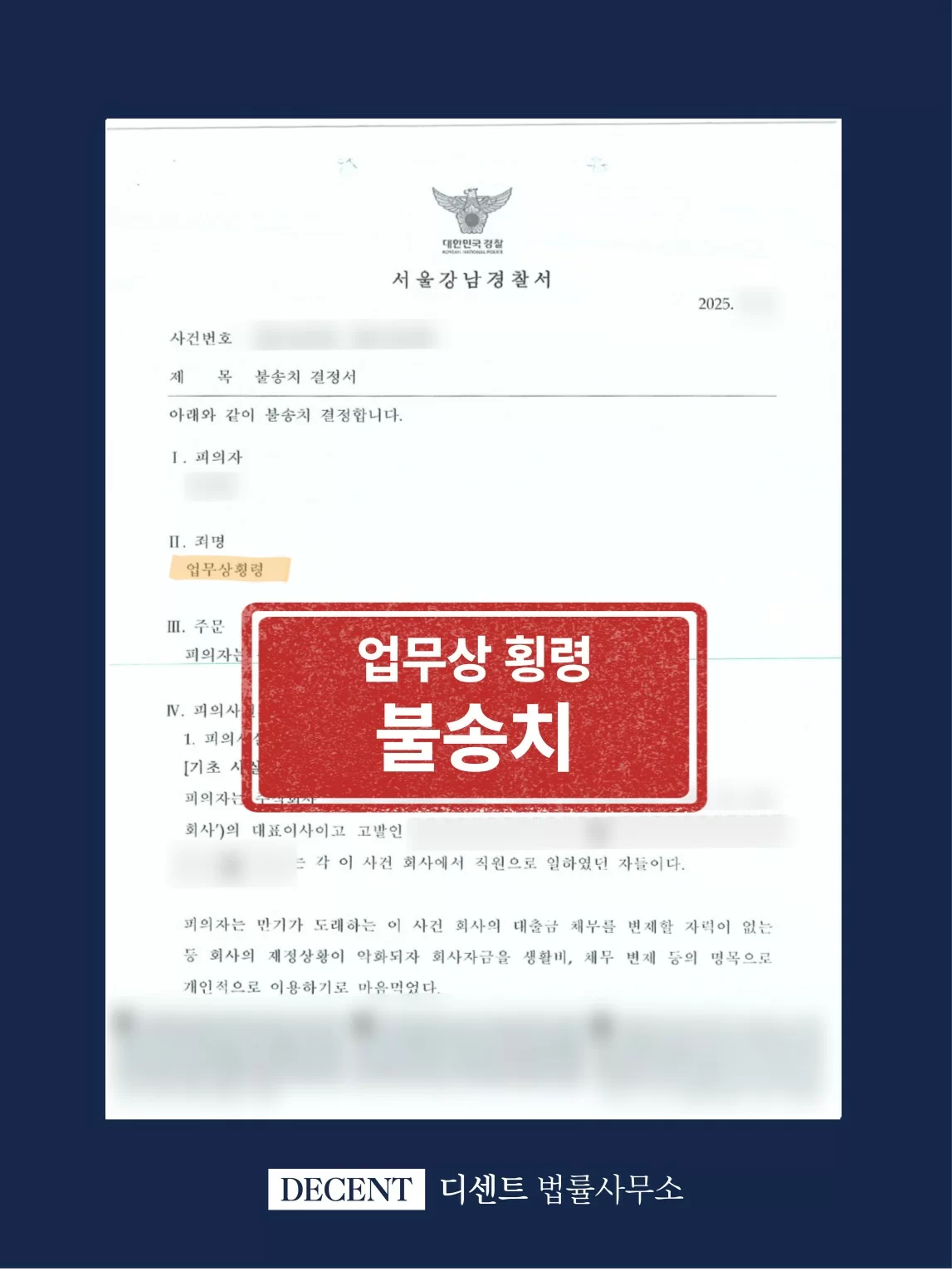
The police found it difficult to recognize an intent of unlawful acquisition for each of the disputed items. As a result, the case was closed with a non-transfer decision on the ground of insufficient evidence.
The KRW 450 million business embezzlement allegation was fully resolved at the investigation stage without proceeding to trial.
In business embezzlement cases, the critical question is not simply whether company funds were used, but why and under what circumstances they were used.
This is especially important in family-owned companies or small corporations, where the line between personal funds and company funds can become unclear. In such cases, CEOs or business owners may face embezzlement allegations even when they were trying to support the company.
If you are facing a criminal complaint for business embezzlement in Korea, it is important to build a defense strategy from the early investigation stage with the assistance of a criminal defense lawyer.
법률상담 안내
모든 상담은 담당 변호사의 사건 검토를 거쳐 진행됩니다.
사건의 주요 내용을 미리 남겨주시면 보다 구체적인 상담을 받으실 수 있습니다.