

A Japanese Corporation’s Acquisition of a Korean Company: From Legal Due Diligence to Foreign-Invested Company Registration
Summary
In a Japanese manufacturing company’s acquisition of a Korean company, we supported legal due diligence and the drafting and execution of the share purchase agreement, and completed the procedures from foreign investment notification to registration as a foreign-invested company following the acquisition of a 100% stake in the Korean company.
Case Overview
- Client Information
- Corporate / Acquirer
- Case Details
The client, a manufacturing company headquartered in Japan, sought to directly acquire a Korean corporation that had long distributed its products in Korea.
The target company imported and sold the Japanese headquarters’ products and maintained stable business relationships with major customers in Korea. The client sought to strengthen its business base in the Korean market by acquiring shares in the corporation and to transfer management control by appointing an executive from the Japanese headquarters as representative director of the Korean corporation.
However, the target company’s operations were centered on longstanding relationships of trust between its existing representative director and major customers, and some significant transactions were conducted without separate written agreements.
The client therefore sought advice from DECENT Law Firm to identify legal risks in the acquisition and proceed with execution of the share purchase agreement and the foreign investment notification and registration procedures.
Key Issues
1. Confirming Share Ownership and Related-Party Transactions
It was necessary to confirm the existing shareholders’ actual ownership of the shares and financial transactions between related parties, and to review legal risks that could become burdens after the acquisition.
2. Maintaining Major Business Relationships after the Change of Control
Since some significant transactions were conducted without written agreements, it was important to determine whether the relationships of trust between the existing representative director and customers could continue after the change of control. We needed to review ways to reflect the existing representative director’s cooperation obligations and business continuity in the contractual terms.
3. Coordinating the Acquisition Agreement with Foreign Investment Notification and Registration
In line with the Japanese corporation’s acquisition of shares in the Korean company, the share purchase agreement had to be drafted and executed, alongside preparation of the documents required for foreign investment notification and foreign-invested company registration and dealings with the relevant authorities.
Decent's Strategy
1. Legal Due Diligence on the Korean Target Company
DECENT Law Firm comprehensively reviewed the target company’s governance structure, related-party transactions, major business contracts, finance-related legal issues, personnel and labor matters, and disputes.
In particular, we analyzed the shareholder register, financial transaction records, and sales and purchase materials to confirm actual share ownership and whether there were irregular financial transactions between related parties. We also reviewed the potential impact of the change of control on existing business relationships where no written agreements had been concluded with major customers.
Based on our findings, we prepared a 30-page legal due diligence report and presented the key legal risks and response measures to the Japanese client.
2. Support for Drafting and Executing the Share Purchase Agreement
Based on the matters identified in legal due diligence, we drafted a share purchase agreement to protect the Japanese corporation’s rights and interests and supported the execution process.
- Confirmations and warranties concerning the existing shareholders’ share ownership and the transfer of shares
- Contractual terms concerning related-party transactions and potential legal risks
- Maintaining business relationships with major customers after the change of control
- The existing representative director’s cooperation obligations and securing business continuity
In particular, we reviewed the existing representative director’s cooperation obligations so that relationships with existing customers could remain stable after the acquisition. While preparing contractual terms favorable to the Japanese corporate buyer, we considered adjustments in light of the seller’s potential acceptance and room for negotiation.
3. Representation in Foreign Investment Notification and Foreign-Invested Company Registration
DECENT Law Firm was authorized by the Japanese corporation to handle the foreign investment notification and carried out the relevant procedures.
We prepared and submitted the foreign investment notification, prepared the necessary supporting documents, and dealt with relevant authorities including KOTRA. We then proceeded with, and completed, foreign-invested company registration following the acquisition of shares in the Korean company.
Results & Significance
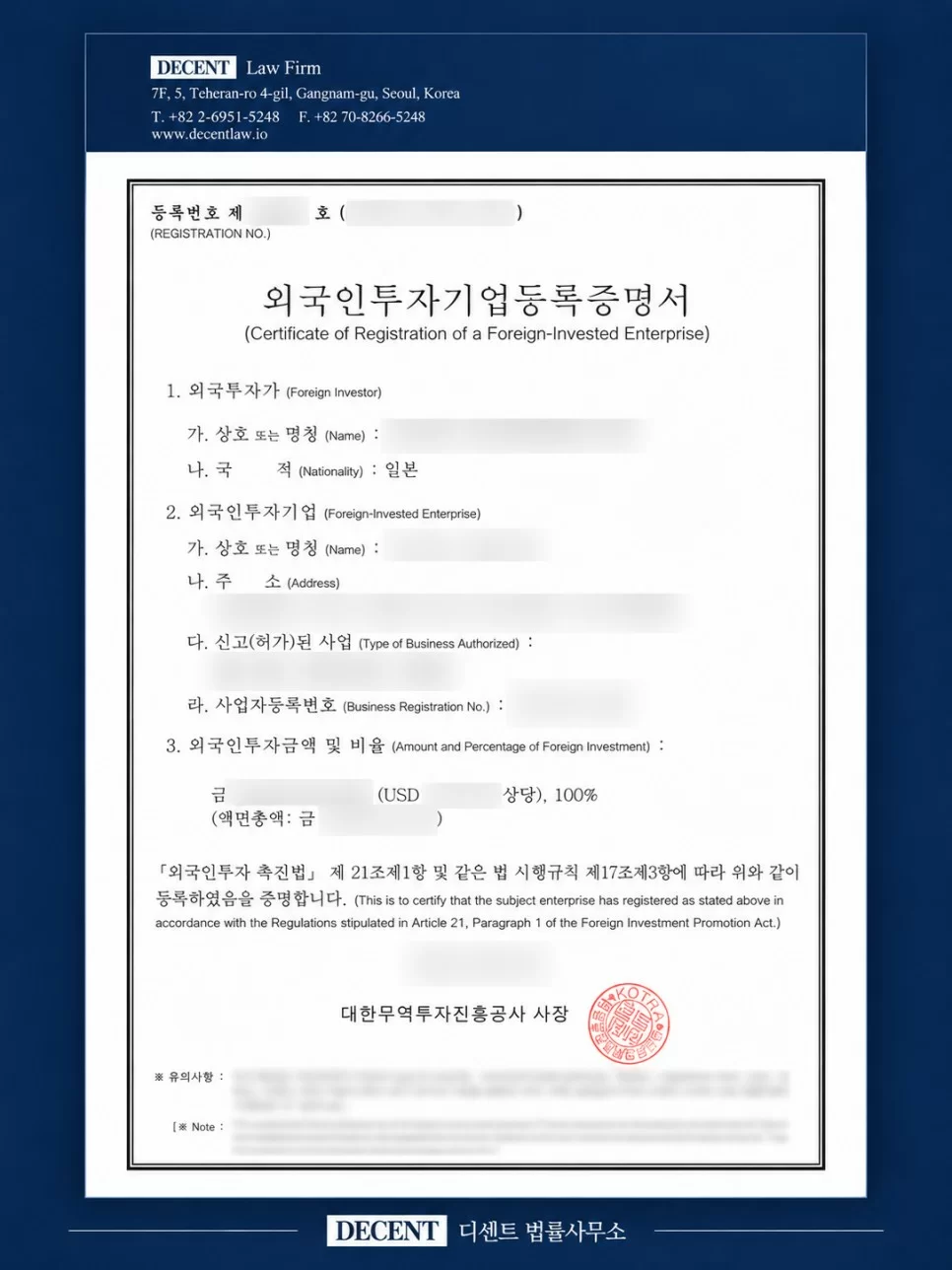
Following DECENT Law Firm’s legal advice and the notification and registration procedures, KOTRA issued a certificate of registration of a foreign-invested company, and registration as a foreign-invested company was completed following the acquisition of a 100% stake in the Korean company.
1. Handling the Process from Legal Due Diligence to Contract Execution and Foreign-Invested Company Registration
In the Japanese corporation’s acquisition of an existing Korean company, we identified key risks through legal due diligence and handled the drafting and execution of the share purchase agreement in coordination with foreign investment notification and foreign-invested company registration.
2. Contract Review Taking Post-Acquisition Business Continuity into Account
The matter is significant in that we reviewed not only the target company’s existing contractual relationships and related-party transactions but also business continuity after the change of control, and provided advice aimed at reflecting these considerations in the contractual terms.
DECENT Law Firm provides legal advice on international corporate transactions, including mergers and acquisitions (M&A) involving Korean and overseas companies, share purchase agreements, foreign investment notification, and foreign-invested company registration.
FAQ
Q1. Does every acquisition of shares in a Korean company by an overseas corporation qualify as foreign investment?
Not every share acquisition qualifies as foreign investment under the Foreign Investment Promotion Act. In principle, foreign investment through share acquisition must meet requirements such as an investment of at least KRW 100 million per foreign investor and ownership of at least 10% of the Korean company’s total voting shares or total capital contributions.
Even where the ownership ratio is below 10%, an investment may qualify as foreign investment if the investment amount requirement is met and an executive authorized to participate in important management decisions is dispatched or appointed. The investment amount, ownership ratio, form of management participation, and target business sector should be examined together.
Q2. How does foreign investment notification differ from foreign-invested company registration?
Foreign investment notification is the procedure for reporting investment details such as the investor, investment amount, and method of share acquisition, while foreign-invested company registration is the procedure for registering the company as a foreign-invested company after the investment is made. Notification alone does not automatically complete company registration.
For the acquisition of existing shares, in principle, advance notification is followed by remittance of investment funds and settlement of the purchase price, with company registration carried out in line with the acquisition of shares. However, in cases specified by law, such as the acquisition of existing shares in a listed corporation, notification may be made within 60 days after acquisition, so the notification timing must be distinguished by transaction type.
Q3. What documents are needed for investment notification and company registration by a foreign corporation?
At the notification stage, documents to prepare include the notification form, a corporate certificate or other documents confirming the overseas corporation’s existence and nationality, and evidence of share acquisition such as a share purchase agreement. Where an agent handles the process, a power of attorney and the agent’s identification are also required.
At the company registration stage, the documents to check include the registration application, the Korean company’s full certificate of registered matters, a copy of its business registration certificate, the shareholder register, relevant agreements, and evidence that the investment has been made, such as a certificate of purchase of foreign currency. The specific documents to submit and any need for translation, notarization, or authentication must be checked according to the issuing country, document type, transaction structure, and the receiving authority’s requirements.
Q4. What should legal due diligence cover before acquiring a Korean company?
The review may cover share ownership and transfer restrictions, the articles of incorporation and major decision-making procedures, related-party transactions, major contracts, licenses and permits, personnel and labor matters, and disputes. Alongside financial and tax due diligence, it is important to identify risks that could become burdens after the acquisition.
Where there are no written agreements with major customers, or agreements contain termination or consent clauses triggered by a change of control, the continuity of the business relationships should be examined. Ways of addressing identified risks in the acquisition price, conditions precedent to closing, the seller’s representations and warranties, and damages provisions may be considered.
Q5. Which provisions are important in an overseas corporation’s agreement to acquire a Korean company?
The number of shares to be acquired, payment method, share transfer and closing procedures, necessary notifications, permits and approvals, the seller’s representations and warranties, and the scope, limits, and claim period for damages need to be specified.
Where the existing representative director’s cooperation is important, the scope and duration of the handover, dealings with major customers, and cooperation obligations necessary for the transfer of management control should also be reviewed. Since the parties are in different countries, it is advisable to address governing law and dispute resolution together.
Related official guidance: KOTRA: Definition of Foreign Direct Investment · KOTRA: Procedures and Documents for Acquisition of Existing Shares · Article 5(2) of the Foreign Investment Promotion Act
Legal Consultation
All consultations are conducted after a case review by the attorney in charge.
Providing the key details of your case in advance will help you receive more specific advice.