

Philippine Joint Venture Agreement Review: Management Control and Recovery of Investment
Summary
Ahead of a joint venture in which a Korean manufacturer would subscribe for new shares in a Philippine company to acquire a 50% stake, we reviewed the investment agreement and shareholders' agreement drafted by local counsel, as well as the local counsel's engagement agreement. DECENT Law Firm identified issues such as the mismatch between shareholding and board structure and the absence of investment recovery mechanisms and source technology protection, and provided a legal review memorandum containing revised clauses in English together with explanations in Korean.
Case Overview
- Client Information
- Corporate / Investor
- Case Details
The client, Company A, is a Korean manufacturer that was pursuing an investment agreement to operate a joint venture with a Philippine company. Company A planned to subscribe for new shares issued by the Philippine company to acquire a 50% stake and to enter into a shareholders' agreement with the local shareholders.
Company A was also planning to build production facilities for the joint venture and provide its manufacturing technology locally.
However, the draft agreements prepared by local counsel contained several problems, including a mismatch between shareholding and actual management control, the absence of investment recovery mechanisms, and the omission of source technology protection clauses.
Before signing, Company A therefore asked DECENT Law Firm to review the investment agreement, the shareholders' agreement, and the local counsel's engagement agreement.
Key Issues
The core of this engagement was the extent to which the agreements could secure the rights Company A could actually exercise after acquiring its stake and control the investment risks.
| Key Issue | Problems in the Draft Agreements |
|---|---|
| Management control | 50% shareholding, but a board composition favoring the local side |
| Investment recovery | No provisions for exiting the stake upon termination of the joint venture or deadlock |
| Source technology | No terms on technology ownership, scope of use, or return |
| Damages | Insufficient financial, tax, and other representations and warranties and liability for breach |
| Overseas remittance | Unclear procedures for foreign investment registration and future dividends and capital repatriation |
| Investment closing | No protection for equipment ordering costs incurred before acquiring the stake |
These problems could not be resolved simply by confirming the investment amount or shareholding ratio, so concrete revisions to protect the investor were needed for each clause.
Decent's Strategy
01. Board Voting Structure and Securing Management Control
The original agreements provided that, of the five directors, the local founders would appoint three and the Korean investor two. The representative director could also be appointed only from among the directors nominated by the local founders. Under this structure, even with a 50% stake, the local side could potentially decide key management matters such as executive compensation, the annual budget, dividends, and bank signatories on its own.
DECENT Law Firm revised the clauses so that a director nominated by the Korean investor could also be appointed representative director, and proposed a reserved matters clause requiring the prior written consent of the investor or its nominated director for important management matters. We also had the inconsistent number of investor-nominated directors between the investment agreement and the shareholders' agreement clearly fixed.
02. Investment Recovery Structure for Termination and Deadlock
The original agreements had no specific procedures for exiting stakes if the joint venture ended or the shareholders reached a deadlock. In the Philippines, capital paid into a company cannot be freely returned merely because an agreement is terminated, and the Revised Corporation Code of the Philippines (RA 11232) sets out statutory procedures for the dissolution and liquidation of corporations. The Supreme Court of the Philippines has also explained the legal restrictions on the return and distribution of corporate capital and the principle of creditor protection.
Taking into account the possibility of termination from the investment stage, DECENT Law Firm proposed adding the following clauses.
- Share purchase and sale procedures: how stakes will be resolved in the event of a material breach or decision-making deadlock
- Tag-along right: the Korean investor's right to sell its shares on the same terms when the local shareholders sell their stake to a third party
- Liquidation provisions: standards for distributing residual assets and handling technology and equipment upon termination of the joint venture
03. Protecting Ownership of Source Technology Provided to the Joint Venture
Company A planned to provide its source manufacturing technology to the Philippine joint venture for local production, but the original investment agreement and shareholders' agreement contained no provisions on ownership or scope of use of the technology. Providing technology in this state could lead to disputes over demands for the return of technical materials or cessation of use after the joint venture ended.
DECENT Law Firm proposed making the execution of a separate Technology License Agreement a condition precedent to closing. Ownership of the source technology would remain with the Korean company, and the joint venture would be granted only a limited license for local production. We also reviewed clauses on ownership of improvements, return of technical materials upon termination, confidentiality, and non-competition.
04. Strengthening Representations, Warranties, and Indemnification
The original agreements contained only basic representations on incorporation and capital structure, and protections concerning financial condition, taxes, permits, and contingent liabilities were insufficient. There were also no specific provisions for compensating losses from a breach of representations and warranties.
DECENT Law Firm proposed supplementing representations and warranties on finance, tax, labor, permits, and contingent liabilities, and adding indemnification provisions for breaches. We also considered clearly reflecting the claim period, liability cap, and minimum threshold for individual claims in the agreements.
05. Managing Risks in Remittance, Dispute Resolution, and Closing
In a Philippine investment, the procedures for repatriating future dividends and investment capital to Korea are also important. Registration of foreign investments with the Bangko Sentral ng Pilipinas (BSP) is not mandatory for all foreign investments, but registration requirements must be checked if foreign currency for capital repatriation and dividend remittance is to be sourced through local authorized banks. With these remittance channels in mind, DECENT Law Firm proposed making foreign investment registration and the provision of supporting documents a contractual obligation.
Where the competent court or arbitral institution had not been fixed, we proposed revisions using international arbitration. Considering that costs such as ordering production equipment could arise before the stake was acquired, we also reviewed clauses on settling and refunding upfront costs and handling equipment and technology if the investment did not close.
Related materials: Revised Corporation Code of the Philippines (RA 11232) · Supreme Court of the Philippines, G.R. No. 144476 (Ong Yong v. Tiu, 2003) · Bangko Sentral ng Pilipinas — Inward and Outward Foreign Investments FAQs
Results & Significance
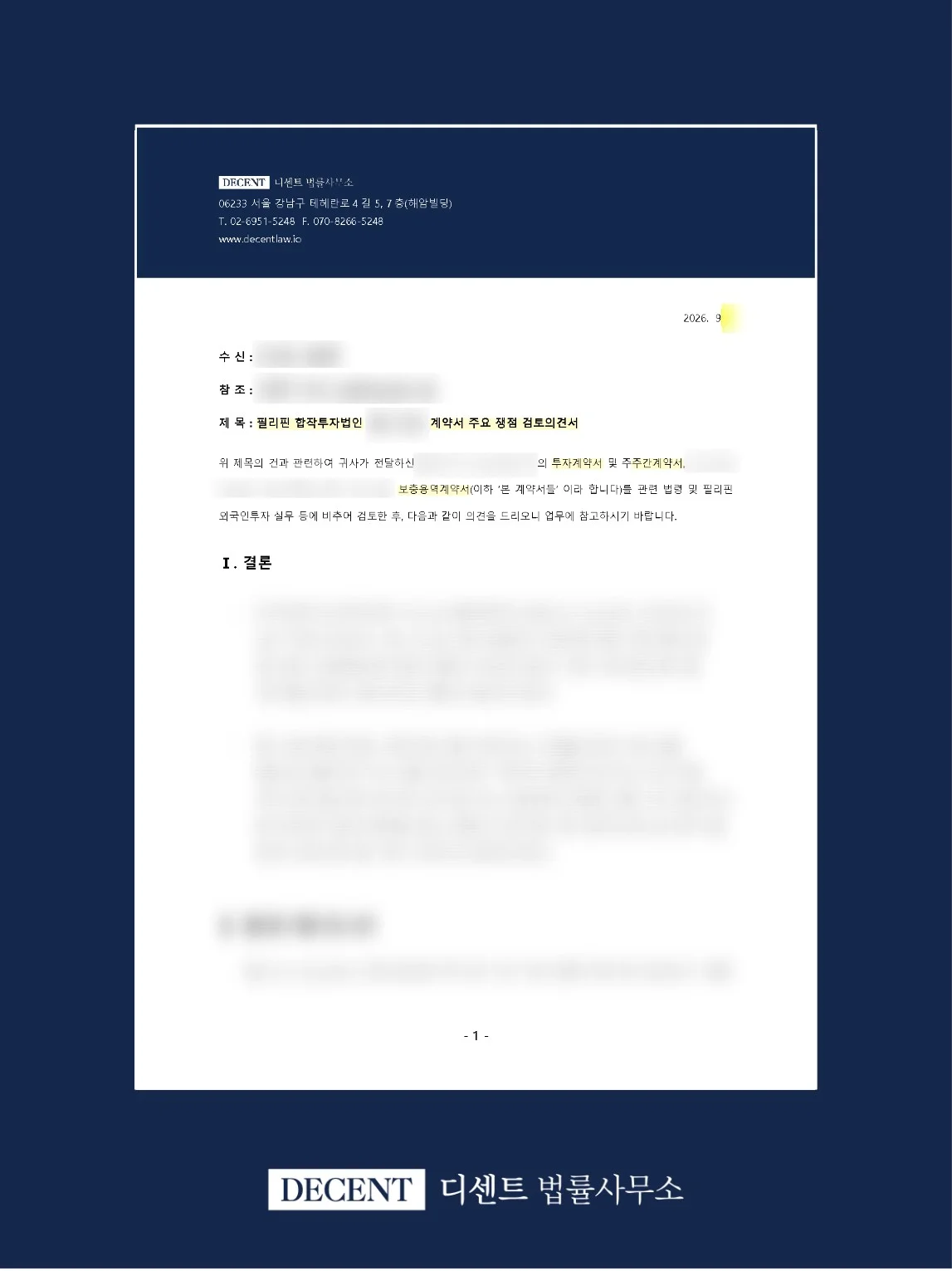
Contract Revision Memorandum to Protect the Investor
DECENT Law Firm completed its review of the investment agreement, shareholders' agreement, and local counsel engagement agreement for the Philippine joint venture, and provided a legal review memorandum with proposed revisions and new provisions for key clauses. The memorandum covered investment recovery, exercise of management control, technology protection, representations, warranties and indemnification, overseas remittance, dispute resolution, and the allocation of costs before closing.
In particular, we prepared revised contract clauses in English together with explanations in Korean so that they could be used directly in negotiations, providing concrete negotiating positions.
Significance of Reviewing Overseas Joint Venture Agreements
This engagement shows that in an overseas joint venture, it is important to review the agreements with a view not only to acquiring the stake itself, but also to actual management control, methods of recovering the investment, protection of core technology, and potential future disputes.
FAQ
Q1. Does holding 50% of a joint venture guarantee management control?
Holding a 50% stake does not guarantee a corresponding level of management control. The shareholding ratio, board composition, authority to appoint the representative director, and consent requirements for key decisions must be reviewed separately.
Q2. How can the investment be recovered when a joint venture ends?
Termination of the agreement alone does not guarantee the return of the investment. It is important to review the available recovery methods in advance, such as selling shares, having the other party buy the shares, or lawful liquidation, and to put the relevant clauses in place.
Q3. Can a Korean company retain ownership of technology provided to a joint venture?
The agreements can be designed so that ownership of the technology remains with the Korean company and only the joint venture's scope of use is restricted. This requires clearly setting out a separate technology license agreement, the return of technical materials, and the conditions for terminating the license.
Q4. Should an investment agreement drafted by local counsel also be reviewed separately?
Even if local counsel drafted the agreement, it should be separately confirmed whether it contains sufficient protections for the investor. Especially where the other side drafted the agreement, key clauses such as investment recovery, management control, indemnification, and technology protection should be reviewed closely.
Legal Consultation
All consultations are conducted after a case review by the attorney in charge.
Providing the key details of your case in advance will help you receive more specific advice.