

Damages Lawsuit Alleging Aiding Fraud Through the Sale of Tether (USDT)
Summary
The client, who had sold Tether (USDT) in an ordinary transaction and received the purchase price, was sued for KRW 30 million in damages on the grounds that he had aided fraud suffered by the buyer. DECENT Law Firm proved that the USDT sale agreement had been performed normally and that there was insufficient evidence of the client's involvement in the fraud or liability for aiding it, and obtained a judgment dismissing the plaintiff's claim in its entirety.
Case Overview
- Client Information
- Individual / Defendant
- Case Details
While selling USDT through person-to-person (P2P) trading, the client received KRW 30 million from a buyer and transferred the agreed amount of USDT to the wallet address designated by the buyer.
The buyer later claimed to have suffered fraud involving a third party and filed a civil lawsuit against the client seeking KRW 30 million plus late payment damages.
The buyer alleged that the client's USDT sale had been used as a money laundering channel for the fraud and that the client was liable for damages for aiding the fraud. The buyer also raised whether the client was an unreported virtual asset service provider and the price difference in the USDT transaction.
Although the client had received payment and transferred USDT under an ordinary virtual asset sale agreement, he faced liability for damages arising from a third party's fraud, and he engaged DECENT Law Firm to defend the lawsuit.
Key Issues
01. Whether the USDT Seller Conspired in or Participated in the Fraud
The key issue was whether the client had conspired in or substantially participated in the third party's fraud. The question was whether involvement in the fraud could be established merely because the client had received the purchase price from the buyer.
02. Awareness of the Fraud and Liability for Aiding
Joint tort liability under Article 760 of the Korean Civil Act may arise not only from intentional aiding but also from negligent aiding. Whether the client could have recognized or foreseen the fraud at the time of the transaction, and whether he breached a duty of care to prevent it, were therefore important factors.
03. Unjust Enrichment and Causation of Damage
At issue was whether the KRW 30 million the client received was a legitimate USDT purchase price or unjust enrichment obtained without legal cause. The parties also disputed whether there was legal causation between the client's sale of USDT and the fraud loss claimed by the buyer.
Decent's Strategy
01. Proving Normal Performance of the USDT Sale Agreement
DECENT Law Firm analyzed the deposits into the client's account and the actual USDT transfers to prove that the transaction had been performed normally under the sale agreement.
Because the client received the purchase price from the buyer and transferred USDT to the designated wallet address, we emphasized that simply receiving payment or providing an account in his own name could not be equated with providing an account for fraud.
02. Rebutting Awareness of and Involvement in the Fraud
The plaintiff argued that the client was liable for aiding fraud, citing the general risk that USDT can be misused for money laundering.
DECENT argued that the general possibility that virtual assets may be used in crimes must be distinguished from whether the seller could have recognized or foreseen a specific fraud at the time of the individual transaction.
We also explained that the client had no relationship with the third party at issue and was not involved in the buyer's investment purposes or subsequent investments, emphasizing that there was insufficient evidence of conspiracy, participation, or liability for aiding.
03. Rebutting the Legal Basis for Unjust Enrichment and Damages
The plaintiff claimed that the client had obtained an unjust profit, pointing to a price difference in the USDT transaction.
DECENT responded that, considering the market price, fees, and transaction terms at the time, a difference in the quantity of USDT transferred did not by itself establish unjust enrichment.
In particular, we emphasized that because the client had actually transferred USDT in exchange for the purchase price, the money could not be regarded as obtained without legal cause.
We also disputed whether there was causation sufficient to establish liability for damages between the investment losses later claimed by the buyer and the client's sale of USDT.
Results & Significance
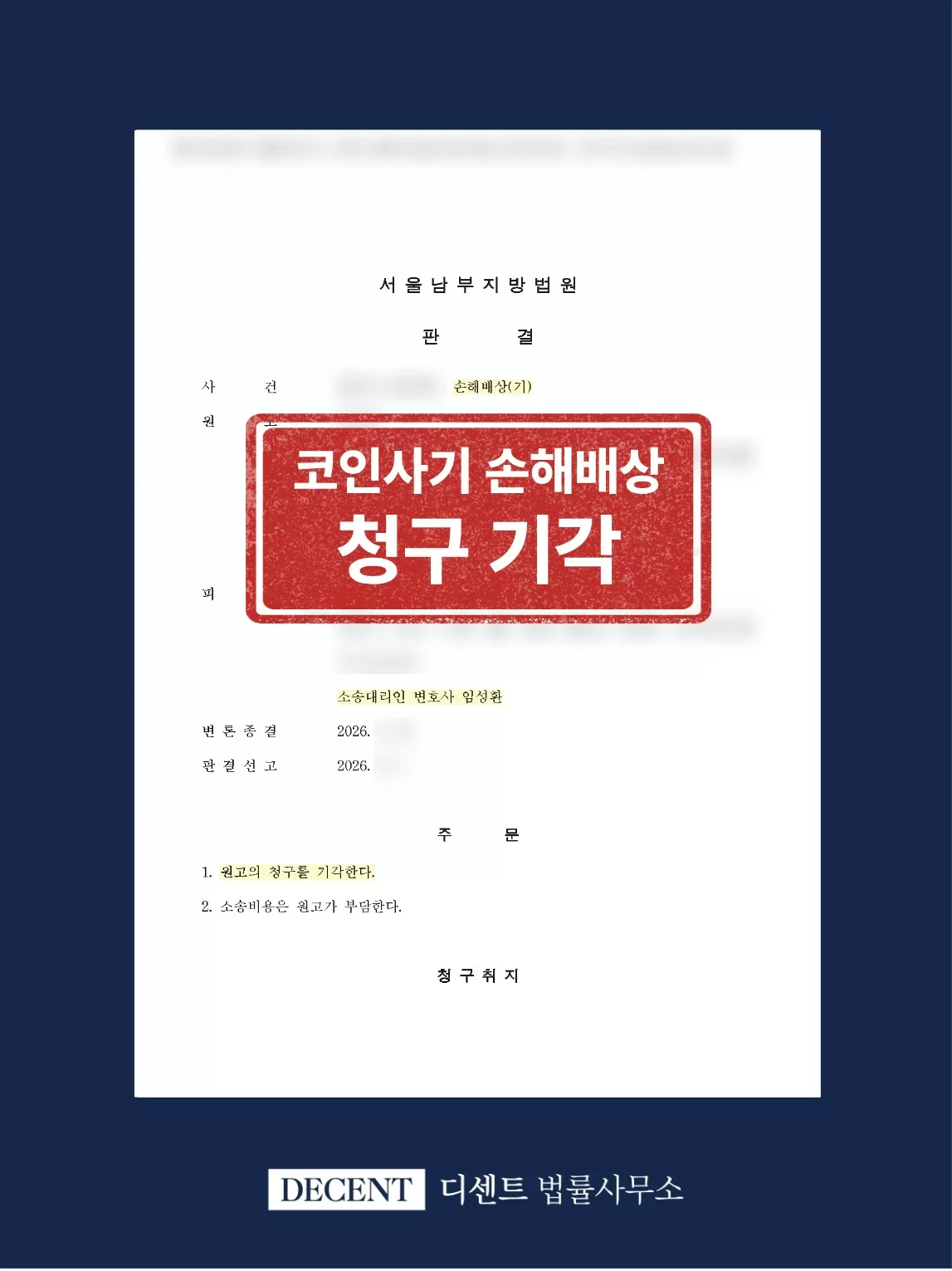
The Seoul Southern District Court dismissed in its entirety the plaintiff's claim for KRW 30 million plus late payment damages and ordered the plaintiff to bear the litigation costs.
The court held that the evidence submitted by the plaintiff was insufficient to establish the client's conspiracy in or participation in the fraud, aiding, or unjust enrichment, and that there was no other evidence to establish them.
This case shows that a virtual asset seller's receipt of the purchase price from a buyer does not by itself give rise to civil liability for damages for a third party's fraud.
DECENT Law Firm rebutted the plaintiff's claims by specifically distinguishing the actual USDT transfer records, the transaction relationship, and the client's awareness of and involvement in the fraud, and as a result fully defended the KRW 30 million damages claim against the client.
FAQ
Q1. If I sold USDT and the buyer was defrauded, am I liable as the seller?
Selling USDT does not automatically make the seller liable for damages for fraud suffered by the buyer. However, liability may arise depending on whether the seller could have recognized or foreseen the fraud and whether the seller did anything to contribute to it.
In this case, the actual performance of the sale agreement and the lack of evidence of involvement in the fraud were decisive.
Q2. If the payment for a crypto trade was fraud proceeds, must I return it as unjust enrichment?
The fact that the payment is connected to fraud does not immediately create an obligation to return unjust enrichment.
The specific facts, such as the validity of the sale agreement, whether USDT was actually transferred, and how you became involved in the transaction, must be confirmed. In this case, we rebutted the unjust enrichment claim on the basis that the client received the purchase price and transferred USDT as agreed.
Q3. What materials do I need if I am sued for aiding fraud after selling USDT?
It is important to secure chats with the buyer, the terms of sale at the time, bank deposit records, USDT transfer records, wallet addresses, and transaction hashes (TXIDs).
In particular, objective materials showing the buyer's requests at the time and how the virtual assets were actually transferred can be important evidence in determining whether you were involved in the fraud and whether the sale agreement was performed normally.
Legal Consultation
All consultations are conducted after a case review by the attorney in charge.
Providing the key details of your case in advance will help you receive more specific advice.