

Successful Defense Against Charges of Professional Breach of Trust and Trade Secret Misappropriation
Case Overview
- Client Information
- Individual / Suspect
- Case Details
-
The Decent Law Firm Virtual Asset Special Task Force successfully represented a client accused of Professional Breach of Trust, Violation of the Commercial Act (Special Breach of Trust), and Violation of the Unfair Competition Prevention and Trade Secret Protection Act. Through our proactive legal intervention during the investigative stage, we secured a Decision of Non-transfer (Acquittal/No Charges) for all counts.
The client was a former executive at a virtual asset-related company. After the client resigned to start a new venture, the former employer faced financial difficulties and sent a notice of claim for damages, followed immediately by a criminal complaint.
The charges were severe, carrying the risk of heavy imprisonment. The complainant alleged that the client had arbitrarily settled referral commissions (rebates) from the Bitget exchange, leaked company funds to third parties, and misappropriated a proprietary trading indicator, which they claimed was a protected trade secret.
Decent's Strategy
The complainant argued that the client misappropriated USDT (Tether) commissions. However, Decent’s legal team argued that the charges were legally groundless.
Under Supreme Court Precedent (2021Do9855), virtual assets like USDT are classified as "pecuniary interests" (재산상 이익) rather than "tangible property" (재물). Since the Korean Criminal Code strictly distinguishes between these two for embezzlement charges, we demonstrated that the charge of professional embezzlement was legally inapplicable regardless of the facts.
2. Special Breach of Trust under the Commercial Act
The complainant alleged that the client illicitly received investment funds from third parties that belonged to the company. We proved that:
• The funds were part of a legitimate personal investment for the client’s independent new entity.
• The funds had no connection to the complainant company’s revenue.
• The assets in question were fully returned to the investor, proving there was no intent to cause damage to the company or seek illicit gain.
3. Misappropriation of Trade Secrets
The complainant claimed that a trading indicator (SWORD_OR_GUN) was a trade secret. We refuted this by analyzing the three legal pillars of a "Trade Secret":
• Non-publicity: We demonstrated that the indicator used data from TradingView (a public platform) and was information accessible to the public.
• Economic Value: We argued the data was a simple visualization of price charts and lacked independent economic utility for future investment decisions.
• Secrecy Management: We proved the company had failed to take "reasonable efforts" to keep the info secret, as they were aware of its use for a long time without objection.
Results & Significance
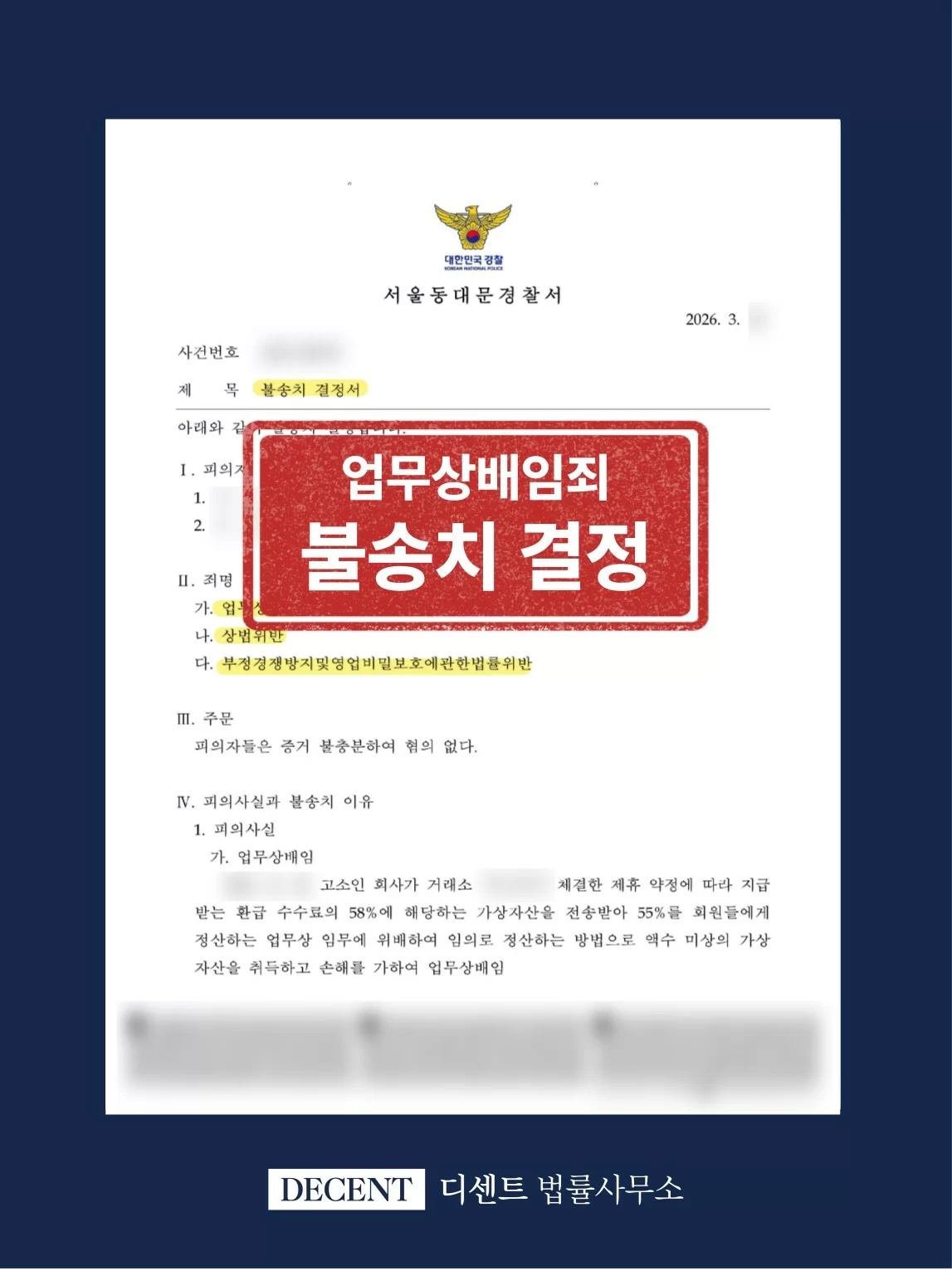
The investigative authorities fully accepted Decent’s arguments. The police determined that:
1. There was insufficient objective evidence to prove the charges, especially after the complainant partially withdrew their claims.
2. The client’s explanation regarding the Bitget commission settlement process was highly credible and consistent with industry standards.
3. As a result, the case was closed without being referred to the prosecution.
Internal disputes within the virtual asset industry—often triggered by broken partnerships or resignations—frequently lead to complex "package" lawsuits involving breach of trust and trade secret theft.
In these cases, an incorrect statement during the initial police interview can lead to a devastating outcome. It is crucial to have a legal team that understands both blockchain technology and complex white-collar criminal law from the very first moment a complaint is filed.
If you are facing criminal allegations related to professional breach of trust or trade secrets in the crypto space, contact Decent Law Firm—where we have the answers you need.
Legal Consultation
All consultations are conducted after a case review by the attorney in charge.
Providing the key details of your case in advance will help you receive more specific advice.
LAWYERS
-
 MP
Hyeonsu “Elliot” Jin
#Cross-border · Dispute Resolution #Crypto #VC · Financial Advisory #IP Litigation #Sports
-
 MP
Pureun “Ian” Hong
#Criminal #Class Action #Crypto #Real Estate Disputes · Construction #Entertainment
-
 P
Sunghwan “Sean” Lim
#Civil #Criminal #Crypto #Cross-border · Dispute Resolution #Real Estate Disputes · Construction
-
 P
Youngyoon ”Yoon” Kwak
#Criminal #Civil #Labor · Employment Disputes #Crypto #Cross-border · Dispute Resolution


