

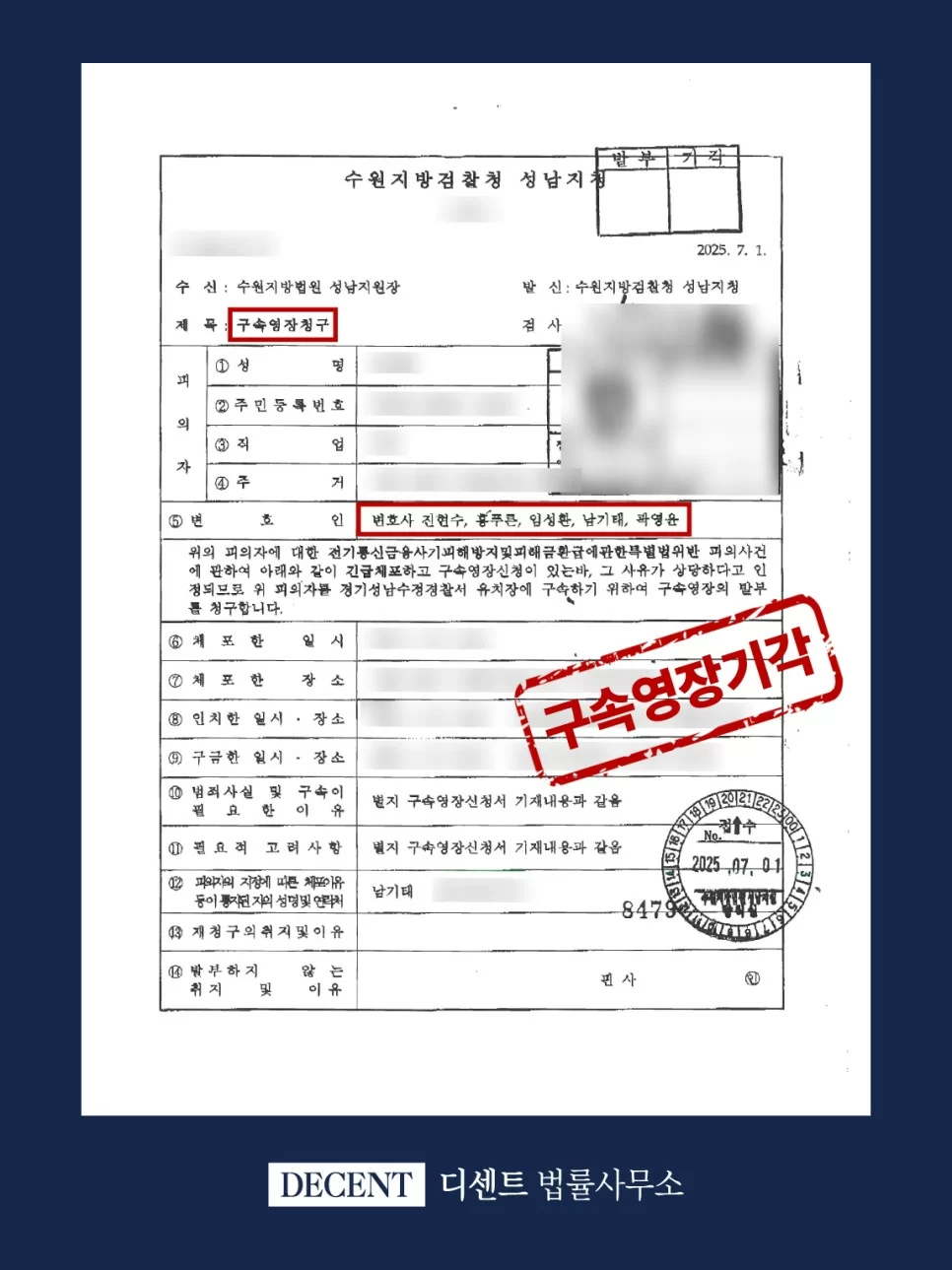
USDT OTC Exchange Allegation in Voice Phishing Case, Arrest Warrant Dismissed
Case Overview
- Client Information
- Individual / Suspect
- Case Details
-
The client was urgently arrested on allegations of being involved in the conversion of voice-phishing proceeds into Tether (USDT) through OTC (over-the-counter) crypto transactions. The client had been staying at the residence of an acquaintance who operated a virtual-asset OTC exchange, and the business premises also served as their shared living space.
Investigators alleged that the client received illicit cash from a voice-phishing cash collector and converted it into USDT for further distribution. Based on the alleged seriousness of the offense, the possibility of reoffending, and concerns about flight risk and evidence destruction, the prosecution sought an arrest warrant.
Decent's Strategy
1. Denial of Participation in the Offense
We demonstrated through objective evidence (including business records and online activity) that the client was not engaged in the OTC exchange’s operations, had no role in handling customer funds, and had not received any share of alleged criminal proceeds. This effectively negated any basis for treating the client as an accomplice.
2. Denial of Criminal Intent
We proved that the OTC operator expressly prohibited the handling of illicit funds and that the client had no involvement in contract execution or customer screening. Accordingly, there was no reasonable basis for the client to know that the funds originated from voice-phishing activities.
3. Challenge to the Necessity of Detention
We emphasized that the client had a fixed residence and stable identity, all relevant evidence had already been seized, and there was no risk of flight or destruction of evidence. The absence of any prior similar offenses further supported the argument that detention was unnecessary.
Results & Significance
Voice-phishing schemes typically operate through a strict division of roles—such as recruiters, collectors, transporters, and exchangers—making it possible for low-level participants to be unaware of the broader criminal structure.
Recently, the use of OTC crypto conversion to obscure the flow of illicit funds has increased, leading to investigations that sometimes extend to legitimate OTC operators and those merely present at the premises.
OTC operators must therefore pay heightened attention to KYC procedures and transaction-purpose verification.
As demonstrated in this case, individuals who are not employees of the exchange or who had no knowledge of the illicit nature of incoming funds can still become entangled in criminal investigations. Early intervention and a precise legal strategy are decisive factors in preventing detention and protecting clients’ rights.
Legal Consultation
All consultations are conducted after a case review by the attorney in charge.
Providing the key details of your case in advance will help you receive more specific advice.
LAWYERS
-
 MP
Hyeonsu “Elliot” Jin
#Cross-border · Dispute Resolution #Crypto #VC · Financial Advisory #IP Litigation #Sports
-
 MP
Pureun “Ian” Hong
#Criminal #Class Action #Crypto #Real Estate Disputes · Construction #Entertainment
-
 P
Youngyoon ”Yoon” Kwak
#Criminal #Civil #Labor · Employment Disputes #Crypto #Cross-border · Dispute Resolution


