

Fraud Allegations over KRW 150 Million in Crypto Referral and Copy Trading Investments
Summary
The client, who handled customer consultations at a company providing virtual asset information, was accused of fraud in connection with futures trading and copy trading investments of approximately KRW 150 million. DECENT Law Firm responded by reviewing the risk disclosure materials, the copy trading agreement, the actual trading records, and the fee structure, and the police issued a non-referral decision on the grounds of no charge (insufficient evidence).
Case Overview
- Client Information
- Individual / Suspect
- Case Details
The client was an employee in charge of customer consultations at a company that provided information on virtual assets. The complainant learned of investment information through the company's YouTube channel, applied for a consultation, and received explanations from the client on how to use an overseas virtual asset exchange and how futures trading works.
The complainant had approximately KRW 100 million worth of Tether (USDT) transferred to his own exchange account and began futures trading. After incurring substantial losses, he invested approximately KRW 50 million more and also used copy trading. Copy trading is a method in which another user's account is linked to a specific trader's trades and automatically follows them.
After further losses, the complainant alleged that the client had induced him to invest by suggesting he could earn high returns, had him set 40x leverage and high-risk stop-loss levels, and had promised to recover his losses by linking his account to a professional trader. He filed a fraud complaint, claiming the client had deceived him in order to earn referral fees from his trading.
Key Issues
01. Referral Fees and the Elements of Fraud
A referral program pays a fee to the referrer when a user signs up for or trades on an exchange using the referrer's code. Receiving such fees does not in itself constitute fraud. However, fraud may become an issue if, in order to earn the fees, a person conceals material investment risks or falsely guarantees returns to induce trading.
Article 347 of the Korean Criminal Act defines fraud as obtaining property or a pecuniary benefit by deceiving another person. In Supreme Court Decision 2003Do7828 (April 9, 2004), the court held that where a duty to disclose circumstances material to a decision to transact is recognized under the principle of good faith, failing to disclose them may also constitute deception.
The key issue in this case was not the investment losses or the fees themselves, but whether the client's specific explanations amounted to deception and what explanations the complainant received before deciding to trade.
Decent's Strategy
DECENT Law Firm attended the police suspect interview and submitted a defense counsel's opinion, examining the complainant's claims against the actual circumstances of the trading.
01. Risk Disclosure Materials for Leveraged Trading
We reviewed the customer confirmation and pledge form prepared at the time of the investment consultation and related materials. They included content on the risk of loss in leveraged trading and the investor's responsibility. Based on the fact that the complainant had heard explanations of the risks and signed the documents, DECENT explained that this was not a case of concealing investment risks or inducing trading by guaranteeing principal or returns.
02. Distinguishing Copy Trading from the Investor's Own Trades
The complainant claimed that the client had deceived him into believing he would be linked to a professional trader and that his entire investment had been liquidated through copy trading. The client stated that he had never described himself as a professional trader and that the arrangement involved copying his own account, which traded based on materials provided by the company.
Based on the copy trading service agreement, trading records, and KakaoTalk conversations, DECENT separated the explanations given from the actual trading history. We also examined whether all losses resulted from the client's trades or whether there were periods in which the complainant traded himself, emphasizing that deception could not be found merely from the fact that losses occurred.
03. Distinguishing the Referral Fee Structure from Deception
We reviewed the structure under which the client, registered as the exchange referrer, received part of the complainant's trading fees, along with the related explanations. We explained that receiving fees must be assessed separately from the claim that the client deceived the complainant into disposing of his property.
Results & Significance
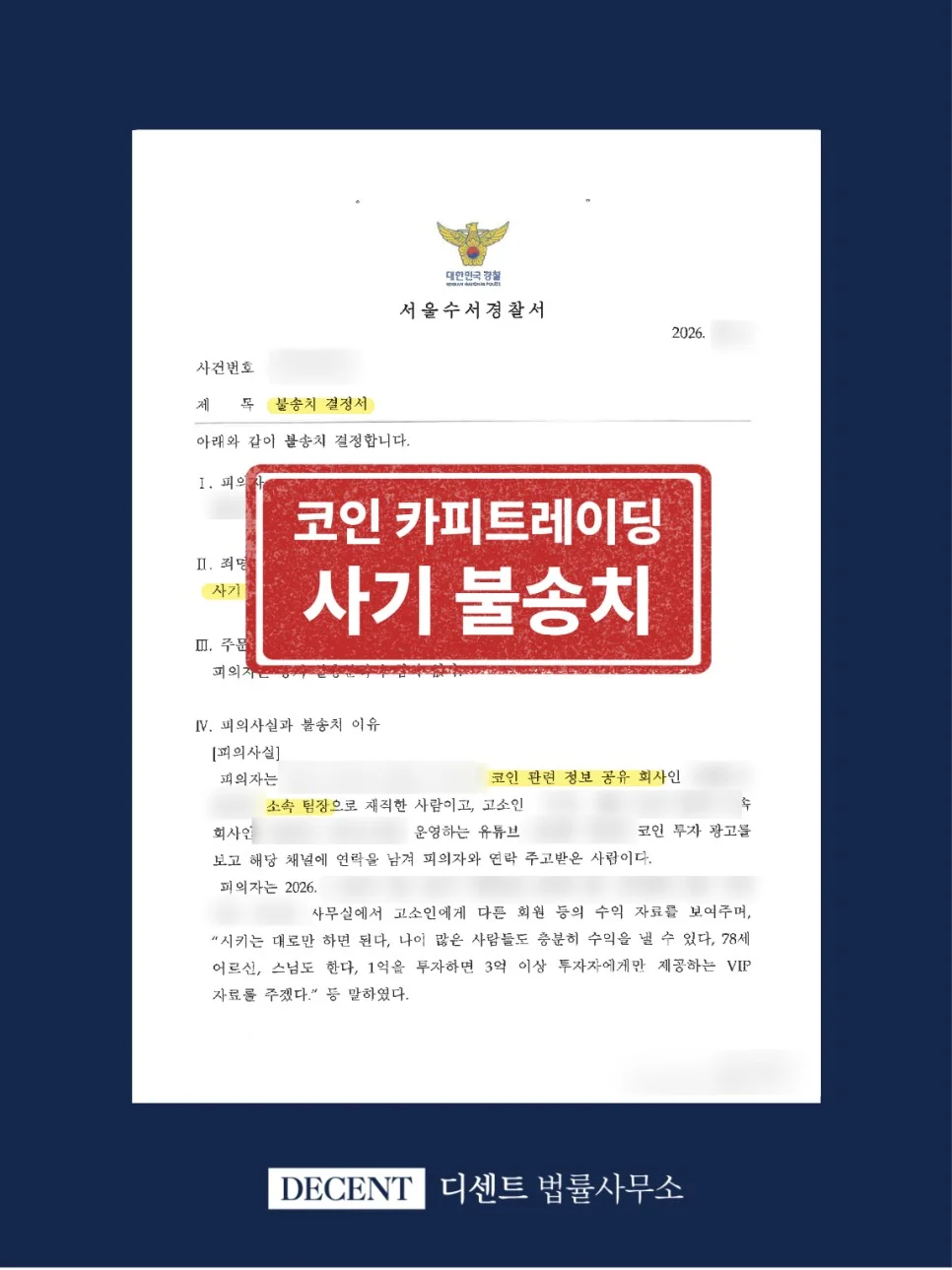
Non-Referral Decision on the Fraud Allegations
Taking into account the statements, trading records, the copy trading agreement, and the customer confirmation and pledge form, the investigators issued a non-referral decision (no charge due to insufficient evidence) for the client. They found insufficient evidence that the client had caused the complainant to make a mistake, dispose of his property, and confer a pecuniary benefit.
| Key Factor | Police Findings |
|---|---|
| Investor's trading experience | The complainant had previously traded virtual assets |
| Risk disclosure | The complainant appeared to have received materials on leverage and loss risks before trading |
| Trading and fee structure | The complainant had set the client as his referrer, and fees arose from trading |
| Proof of deception | It was difficult to conclude that deception caused the complainant to dispose of his property |
Distinguishing Investment Losses from Criminal Liability for Fraud
This case examined the advance disclosure materials, the investor's trading experience, the copy trading agreement, and the referral fee structure together with the objective trading history.
Related laws: Criminal Act Article 347 · Related case law: Supreme Court Decision 2003Do7828 (April 9, 2004)
FAQ
Q1. If copy trading causes investment losses, is the person handling the trades or receiving referral fees guilty of fraud?
Copy trading can cause large losses depending on leverage settings and market volatility. Losses alone do not immediately establish fraud by the person who guided the trading or received referral fees. Conversely, criminal liability may become an issue if returns were guaranteed, material risks were concealed, or false explanations about the trading method were given.
Q2. What should I check if I have been accused over crypto investment losses?
In similar complaint cases, it is important to check not only the size of the losses but also the advance explanations given, the actual trading records, and how any fees were earned.
Legal Consultation
All consultations are conducted after a case review by the attorney in charge.
Providing the key details of your case in advance will help you receive more specific advice.