

Partnership NDA Review and Confidentiality Clause Design Advisory
Case Overview
- Client Information
- Corporate / Business Entity
- Case Details
-
The client was preparing to enter into a business partnership agreement and needed to disclose commercially sensitive information to the counterparty, including its revenue model and key partnership terms.
The counterparty had provided an initial draft of a non-disclosure agreement, but the client was uncertain whether the draft offered sufficient protection for its confidential business information. The client therefore requested a legal review from Decent Law Firm.
The draft defined confidential information and permitted uses only in broad terms. It also lacked detailed procedures for handling information after termination and did not provide sufficiently specific remedies for a breach.
Decent's Strategy
▪️Expanded Scope of Confidential Information
The definition of confidential information was expanded to include the existence of the agreement and the fact that the parties were discussing or entering into a partnership.
This allowed the client to control not only the disclosure of business information, but also the disclosure of the partnership relationship itself.
▪️Limitation on Permitted Use
The permitted use of confidential information was limited to discussions, review, and performance directly related to the relevant partnership agreement.
This restriction was designed to prevent the counterparty from using the disclosed information for unrelated projects or competing business activities.
▪️Duration and Exceptions
The confidentiality obligations were structured to survive termination without a fixed expiration date.
At the same time, objective exceptions were included so that the obligations would cease to apply where the information had lawfully entered the public domain or no longer required protection.
▪️Return and Destruction Procedures
New provisions required all confidential materials, including paper documents, electronic files, and copies, to be returned or securely destroyed once the purpose of disclosure had been fulfilled.
The agreement also established a clear process for confirming the return or destruction of such materials.
▪️Strengthened Remedies for Breach
A contractual penalty provision was added to strengthen deterrence and establish liability for unauthorized disclosure or use, regardless of whether the client could immediately prove the full extent of its actual damages.
During the review, the client also requested a provision allowing it to suspend or waive settlement payments if the counterparty breached the agreement.
However, directly inserting such a provision into the NDA could have conflicted with the payment and settlement structure already governed by the principal partnership agreement.
Instead, Decent Law Firm drafted a clause treating a breach of the NDA as a material breach of the principal partnership agreement. This preserved the existing settlement structure while enabling practical remedies, including termination of the partnership agreement and suspension of access to the relevant technology or systems.
Results & Significance
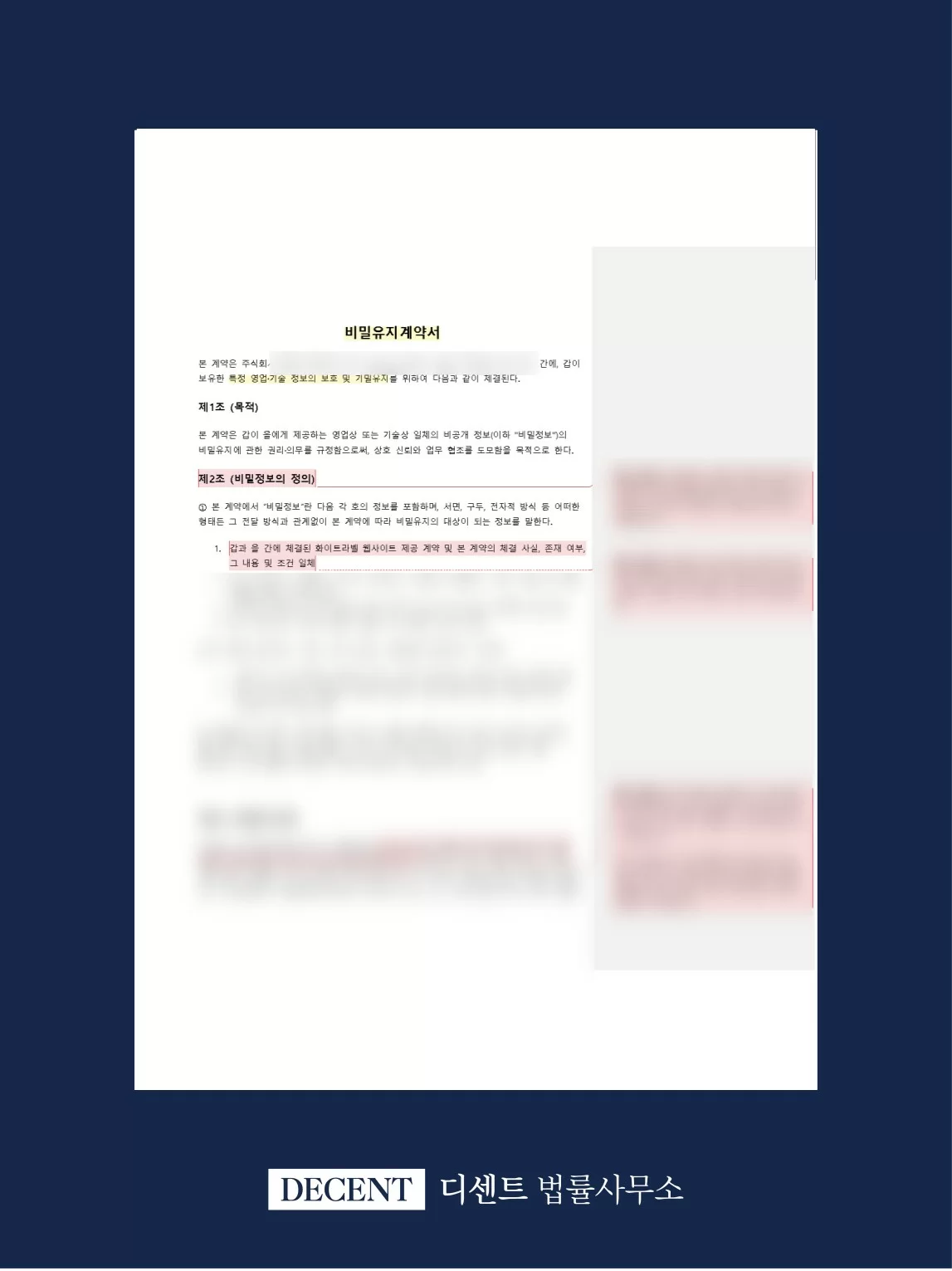
The revised NDA clearly defined the scope and permitted use of confidential information and established detailed procedures for post-termination return and destruction.
It also strengthened the available remedies for breach and connected confidentiality violations to the material breach provisions of the principal partnership agreement.
The client received a revised NDA designed to protect sensitive business information without disrupting the contractual structure of the underlying partnership.
Legal Consultation
All consultations are conducted after a case review by the attorney in charge.
Providing the key details of your case in advance will help you receive more specific advice.