

Legal Review of an App Source Code Transfer Agreement
Case Overview
- Client Information
- Corporate / Business Entity
- Case Details
-
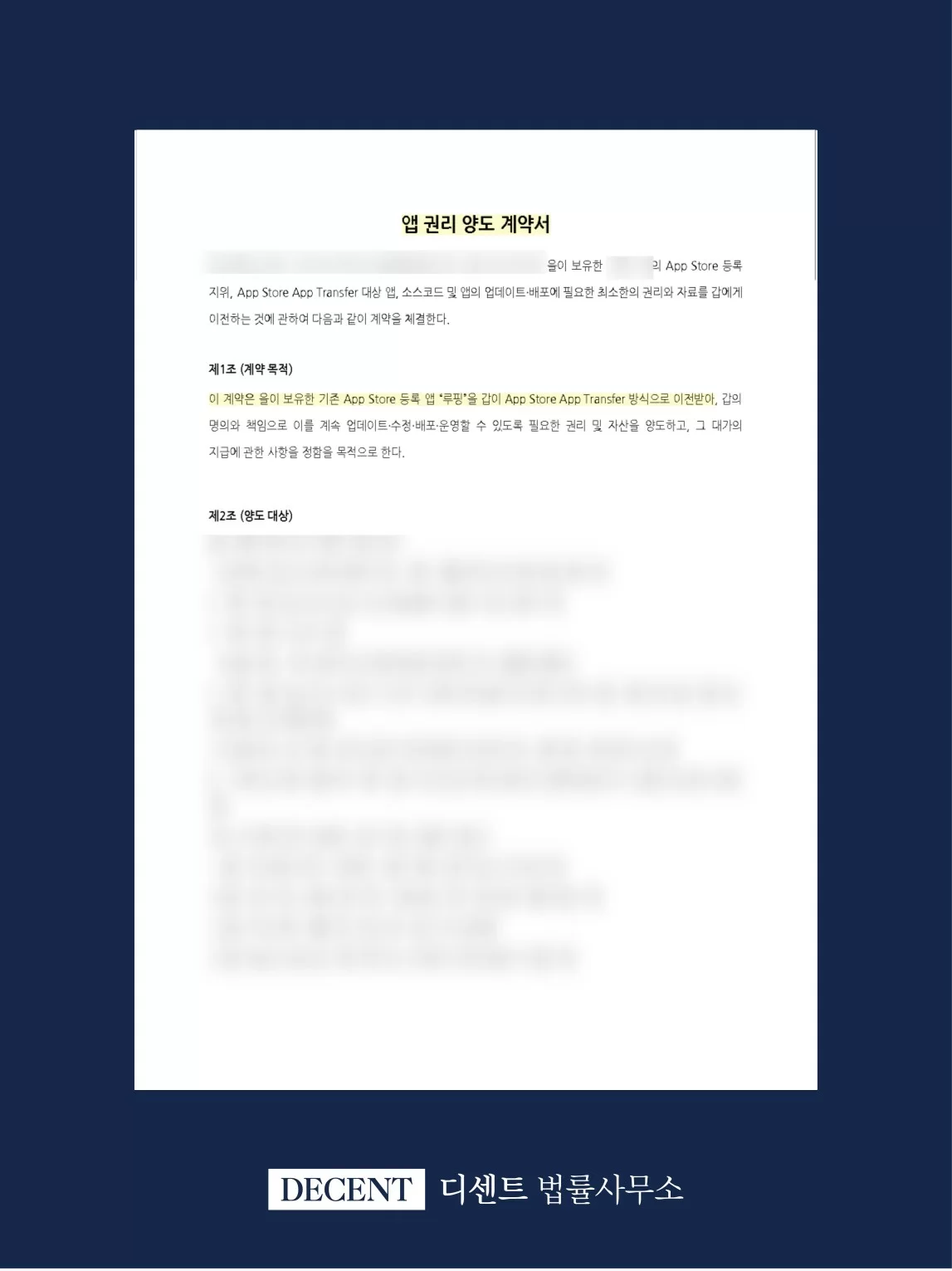
The client was a company reviewing an agreement to acquire an existing mobile application, including its App Store registration status, source code, and materials required for future updates and distribution.
The draft agreement included provisions on App Store transfer, source code delivery, and handover of operational materials. However, the client also had a separate upstream contract with its own customer.
Under that upstream contract, delay-related liquidated damages and contract termination could become an issue. Therefore, reviewing only the app transfer agreement was not sufficient to identify the full scope of contractual risk.
The client requested Decent Law Firm to review the app rights transfer agreement and advise on the overall contract structure.
Decent's Strategy
First, we analyzed the customer’s potential leverage, including the right to claim liquidated damages for delay and the possibility of contract termination. We then assessed the scope within which the client could realistically negotiate with the customer.
Based on this analysis, we divided the response strategy into two scenarios: where negotiation with the customer was possible, and where such negotiation would be difficult.
If negotiation with the customer was possible, we advised the client to first consider an amendment agreement adjusting the delivery schedule, acceptance criteria, and responsibility for App Store approval.
If negotiation with the customer was difficult, we advised the client to strengthen the agreement with the app transferor, especially regarding the scope of transferred rights, post-transfer cooperation, third-party infringement liability, payment conditions, and damages provisions.
Specifically, Decent Law Firm reviewed and improved the agreement with a focus on the following points.
1. Scope of Transfer
We reviewed whether the source code, operational materials, configuration information, and metadata were sufficient for the client to operate the app in practice.
2. Account and Platform Access
We reviewed whether the scope and timing of cooperation for App Store App Transfer and developer account reset or transfer procedures were clearly defined.
3. Third-Party Rights
We checked whether the agreement included obligations to disclose third-party licenses, including open-source software, SDKs, fonts, images, and other third-party elements used in the app.
4. Completion of Handover
We reviewed whether the completion of App Transfer, source code delivery, and handover of listed materials were properly linked to the point at which the transfer would be deemed complete.
5. Post-Transfer Cooperation
We reviewed whether the transferor’s obligations to provide follow-up support, respond to technical questions, supplement missing materials, and cooperate with account-related procedures were sufficiently specific.
6. Payment Conditions
We advised that final payment should be linked to confirmation that the app could actually be built, run, updated, and distributed in practice.
Results & Significance
This engagement was not limited to revising the wording of the app transfer agreement.
Decent Law Firm identified that the app transfer agreement and the client’s upstream customer contract were closely connected. We therefore reviewed the risks within the overall contract structure, rather than treating the app transfer agreement as an isolated document.
As a result, the client was able to first assess the possibility of negotiation with its customer, while also strengthening the contract with the app transferor in terms of transferred rights and post-transfer responsibilities.
In particular, Decent Law Firm helped the client establish practical safeguards around source code delivery, App Store App Transfer, third-party licenses, account access, and payment conditions, all of which directly affect whether the app can actually be operated after acquisition.
Legal Consultation
All consultations are conducted after a case review by the attorney in charge.
Providing the key details of your case in advance will help you receive more specific advice.