

Crypto Referral and USDT OTC Exchange Fraud Accomplice Allegations: Police Non-Referral on All Charges
Case Overview
- Client Information
- Individual / Suspect
- Case Details
-
Our client was primarily engaged in a crypto referral business and also handled USDT P2P and OTC exchange transactions.
The client was accused by an alleged victim of investment fraud and was criminally reported for three charges: fraud, violation of the Act on the Regulation of Conducting Fund-Raising Business without Permission, and violation of the Electronic Financial Transactions Act.
The complainant claimed to have suffered substantial losses after being encouraged to invest in cryptocurrency through an online investment community. The complainant then identified our client as an accomplice, alleging that our client had processed the USDT OTC exchange for the investment funds.
The complainant argued that our client had conspired with the operators of the investment community, participated in the fraudulent scheme, and provided a bank account or access medium while knowing that it would be used for criminal purposes.
Decent's Strategy
1. Proving the Absence of Conspiracy
We demonstrated that the client had no conspiratorial relationship with the operators of the investment community.
The client was not aware of the existence or structure of the investment service and did not know how the customer had been introduced. We submitted supporting materials to show that there had been no communication, agreement, or coordination between the client and the operators of the alleged fraudulent scheme.
2. Establishing the Independence of the Exchange Transaction
We compared the amount received from the complainant with the actual USDT transfer records.
By organizing the bank transaction records, fee deductions, wallet addresses, and blockchain transfer history, we showed that the client had merely processed the requested USDT transfer after deducting the agreed fee, and had not participated in the solicitation, management, or operation of the investment funds.
3. Showing the Lack of Criminal Awareness
We secured records showing that the client had notified the counterparty in advance that transactions involving illegal funds or unlawful purposes would not be accepted.
These records supported the position that the client had no knowledge that the transaction could be connected to any fraudulent activity.
4. Attorney Attendance During Police Questioning
An attorney from Decent Law Firm attended the police questioning with the client and assisted throughout the investigation process.
We helped ensure that the client’s statements accurately reflected the actual transaction structure and did not create unnecessary misunderstandings regarding conspiracy, intent, or involvement in the alleged investment scheme.
Results & Significance
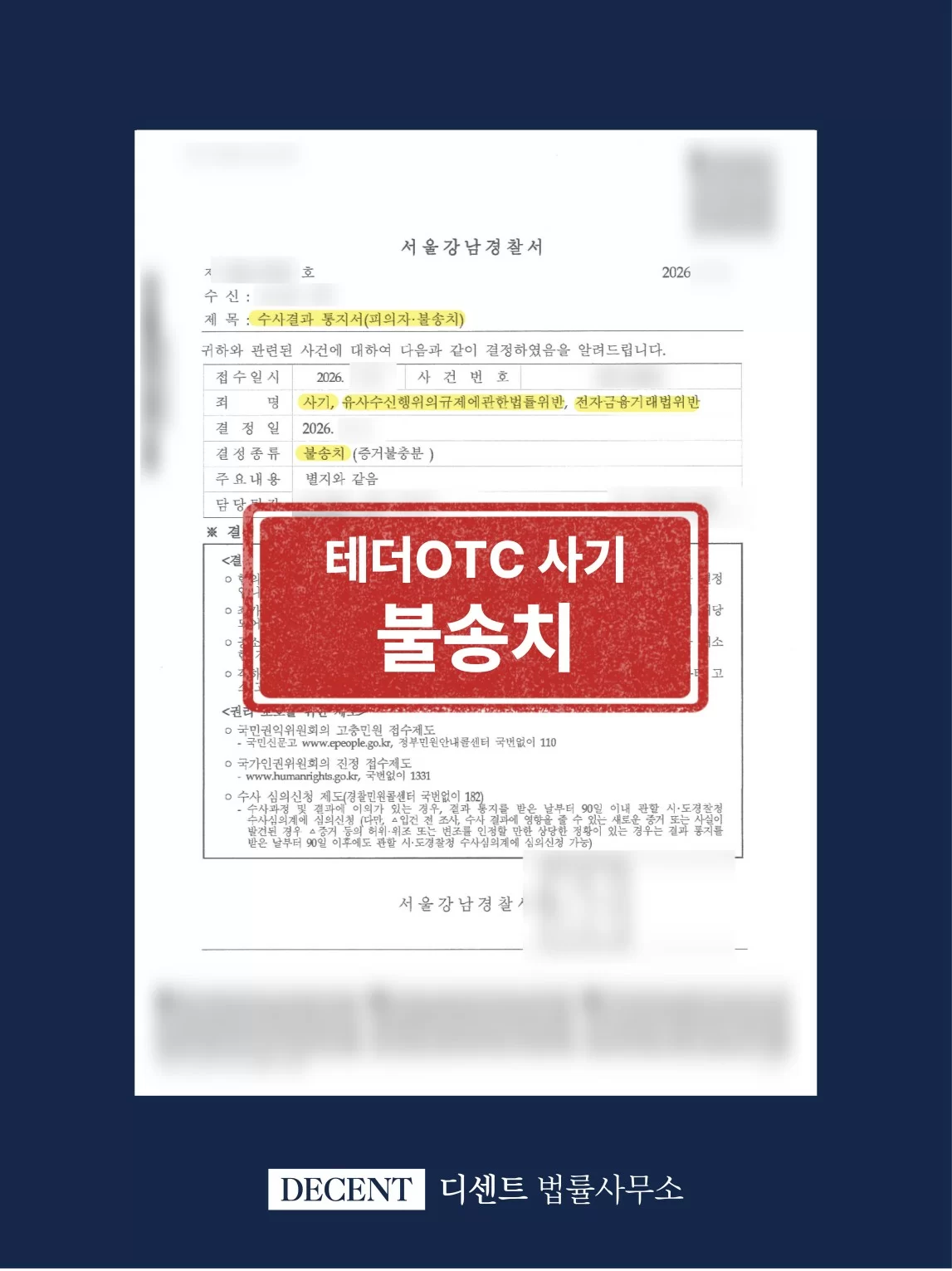
The investigative authority found insufficient evidence to conclude that the client had conspired with the operators of the investment community.
It also considered the fact that the client had actually transferred USDT corresponding to the amount received from the complainant, after deducting the agreed fee.
The authority further found insufficient evidence to conclude that the client had provided a bank account or access medium while knowing that it would be used for criminal purposes, or that the client had participated in the solicitation or management of investment funds.
As a result, the client received a police non-referral decision on all three charges: fraud, violation of the Act on the Regulation of Conducting Fund-Raising Business without Permission, and violation of the Electronic Financial Transactions Act.
Legal Consultation
All consultations are conducted after a case review by the attorney in charge.
Providing the key details of your case in advance will help you receive more specific advice.