

No Charges in Alleged Criminal Proceeds Concealment Case Involving KRW 630 Million Transfer
Case Overview
- Client Information
- Individual / Suspect
- Case Details
-
Our client, Mr. A, had maintained a long-standing financial relationship with an acquaintance, Mr. B, for more than 10 years.
During that time, Mr. B committed a large-scale fraud against a construction company, and approximately KRW 630 million of the fraud proceeds was transferred into Mr. A’s bank account.
Mr. A believed the transfer was repayment of existing debts arising from their prior financial dealings and used the funds to repay loans and credit card balances.
The construction company subsequently filed a criminal complaint against Mr. A, alleging violations of the Act on Regulation and Punishment of Criminal Proceeds Concealment, embezzlement, and aiding violations of the Financial Real Name Transaction Act.
After becoming subject to a police investigation, Mr. A retained DECENT Law Firm for legal representation.
Decent's Strategy
▪️ Lack of Knowledge Regarding Criminal Proceeds
Mr. A and Mr. B had engaged in frequent financial transactions over many years. DECENT submitted the complete transaction history dating back to the opening of the accounts to demonstrate the existence of a long-term lending and repayment relationship.
Based on these records, DECENT argued that the KRW 630 million transfer could reasonably be understood as repayment of an existing debt, and that Mr. A had no knowledge that the funds originated from fraud.
▪️ No Basis for Embezzlement Charges
The complainant also alleged embezzlement. However, under Korean criminal law, embezzlement requires that the accused hold the property in a custodial capacity (Korean Supreme Court Decision 2016Do18761, en banc, Feb. 18, 2021).
DECENT argued that Mr. A had received the funds as repayment of debt, not as a custodian of another person’s property, and therefore the legal elements of embezzlement were not satisfied.
▪️ Submission of Civil Court Judgment
Separately from the criminal complaint, the construction company filed a civil lawsuit seeking damages against Mr. A.
DECENT later submitted the favorable civil judgment during the prosecution stage. The civil court held that it could not be conclusively established that Mr. A knew the transferred funds were fraud proceeds at the time he used them, and dismissed all claims against him.
This ruling became a significant factor supporting the prosecution’s final decision not to indict.
Results & Significance
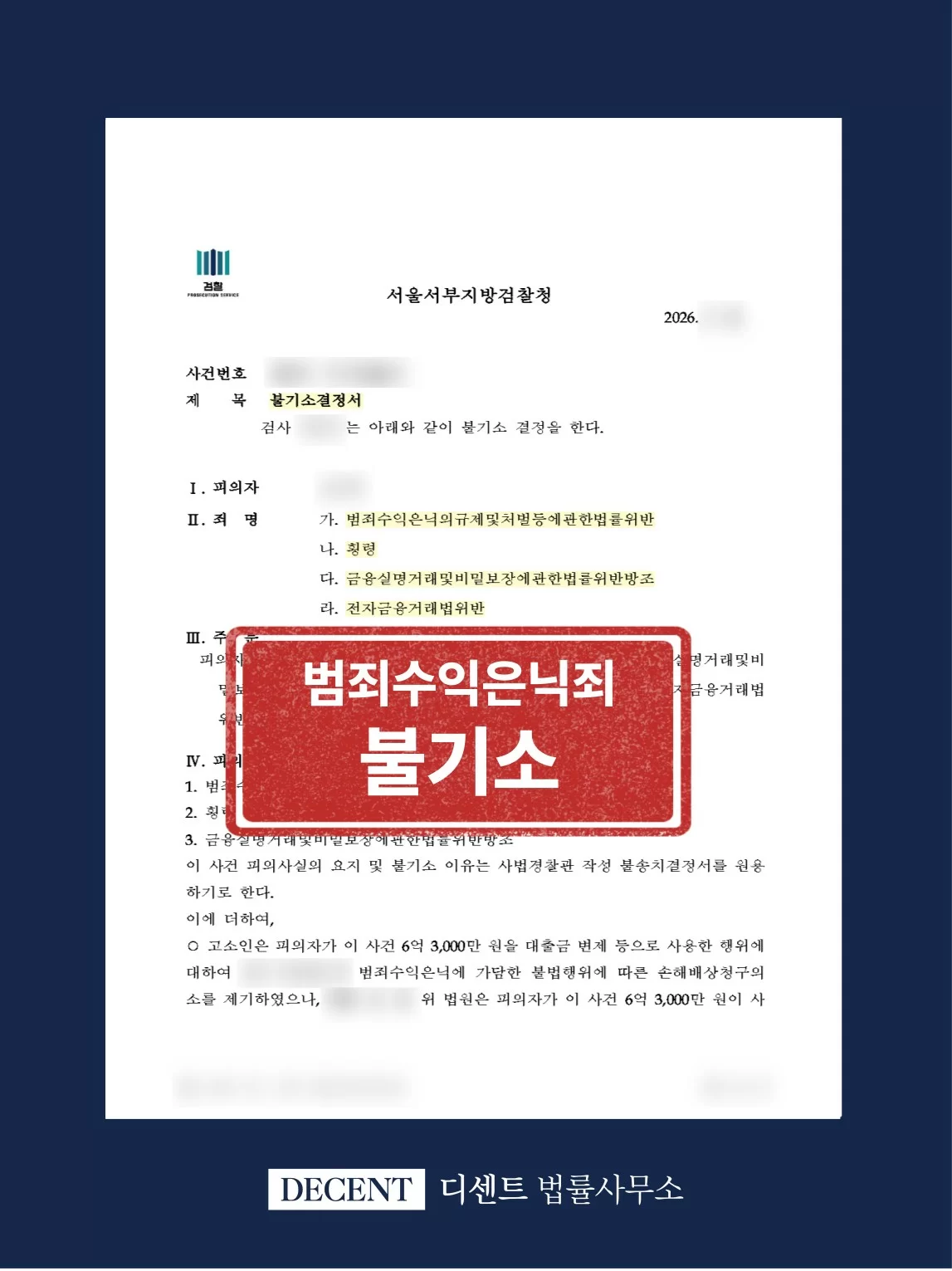
Following DECENT’s submission of a legal opinion, the police issued a non-referral decision based on insufficient evidence.
Although the complainant objected and the matter was forwarded to the Seoul Western District Prosecutors’ Office, the prosecution ultimately issued a non-indictment decision on all allegations — including concealment of criminal proceeds, embezzlement, and aiding violations of the Financial Real Name Transaction Act — citing insufficient evidence.
Mr. A was cleared of all allegations at both the police and prosecution stages.
Legal Consultation
All consultations are conducted after a case review by the attorney in charge.
Providing the key details of your case in advance will help you receive more specific advice.
LAWYERS
-
 MP
Hyeonsu “Elliot” Jin
#Cross-border · Dispute Resolution #Crypto #VC · Financial Advisory #IP Litigation #Sports
-
 MP
Pureun “Ian” Hong
#Criminal #Class Action #Crypto #Real Estate Disputes · Construction #Entertainment
-
 P
Sunghwan “Sean” Lim
#Civil #Criminal #Crypto #Cross-border · Dispute Resolution #Real Estate Disputes · Construction


