

Successful Claim for Damages Arising from a Health Supplement Supply Agreement
Case Overview
- Client Information
- Corporate Client / Plaintiff
- Case Details
-
The client, Company A, is a business that develops and sells health supplement products in collaboration with YouTube creators.
For the launch of a new product, the client entered into a supply agreement with a food manufacturer for the production and delivery of approximately 20,000 units of a protein snack. The contract clearly specified key nutritional requirements: 11g of protein and 0g of sugar per serving. These specifications formed the core concept of the product and were central to the planned marketing and sales strategy, which emphasized a “high-protein, zero-sugar” profile.
However, independent nutritional testing commissioned by the client revealed that the delivered products significantly deviated from the agreed specifications. The actual protein content was approximately 7g, and sugar content of 7–8g was detected. Despite this discrepancy, the manufacturer denied responsibility, submitting its own test report and insisting that the products complied with contractual obligations.
As a result, the product’s core marketing concept collapsed, making normal sales virtually impossible. Nevertheless, the manufacturer attempted to avoid liability by arguing that the products had been delivered as agreed.
Faced with substantial losses caused by this contractual breach, the client decided to pursue a damages claim and sought legal representation from Decent Law Firm.
Decent's Strategy
The core issue was not “how much the client spent,” but rather “how much profit the client would have earned had the contract been properly performed.”
Based on this perspective, the team implemented the following strategy:
1. Reframed the agreement as a custom-made supply contract, emphasizing that compliance with the nutritional specifications was an essential contractual condition.
2. Directly contrasted the manufacturer’s test report with the independent test results obtained by the client, demonstrating that the numerical discrepancies alone clearly established a contractual breach.
3. Calculated damages based not on mere cost reimbursement, but on lost resale profits (expectation damages) that would have been generated through normal product sales.
Results & Significance
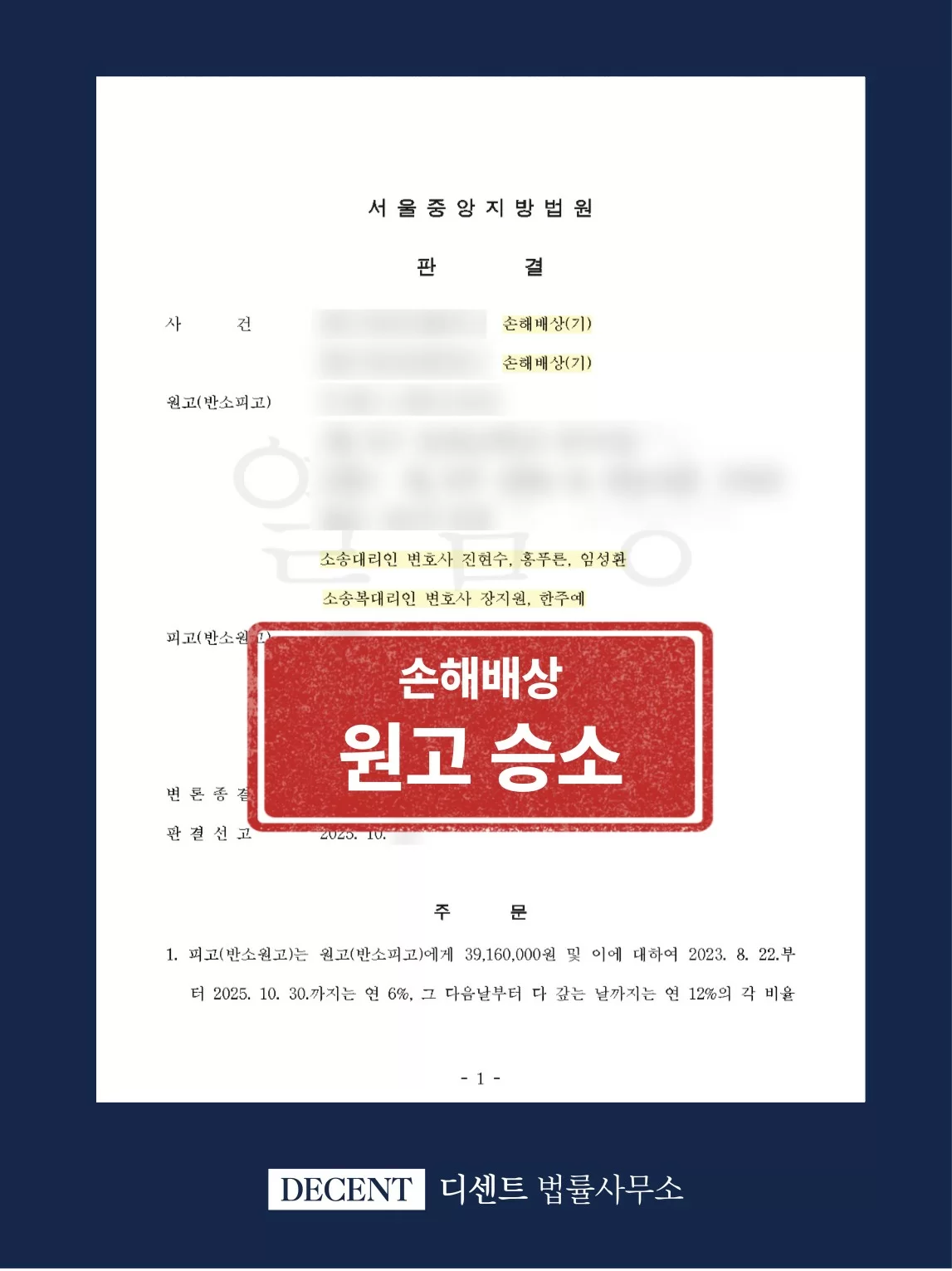
The court accepted the arguments presented by Decent Law Firm and held the manufacturer liable for breach of contract.
Accordingly, the court recognized approximately KRW 40 million in lost resale profits as recoverable damages and ordered the manufacturer to pay this amount along with statutory delay interest. The judgment was rendered with provisional enforcement, ensuring practical recoverability.
As a result, the client successfully secured recognition of the core damages claimed and achieved a meaningful path toward actual recovery.
Legal Consultation
All consultations are conducted after a case review by the attorney in charge.
Providing the key details of your case in advance will help you receive more specific advice.