

Successful Claim for Refund of Business Transfer Payment After Seller Failed to Complete Name Transfer
Case Overview
- Client Information
- Individual / Plaintiff
- Case Details
-
The client entered into a business transfer agreement to acquire a franchised restaurant in Korea. The transfer price included goodwill, the lease deposit, and inventory-related costs, and the client paid the amount in installments.
Under the agreement, the seller was required to transfer the business name and related operating status once the full payment was completed. However, even after the client paid the final installment, the name transfer was not completed.
It later became clear that, after the agreement was signed, a provisional attachment had been placed on the seller’s right to receive the return of the lease deposit. Because this issue remained unresolved, the business name transfer was also delayed.
Despite repeated requests from the client, the seller continued to state that the issue would be resolved soon, but no meaningful action was taken for several months after full payment.
The client then gave the seller a final notice through KakaoTalk, setting a deadline for performance and stating that the agreement would be rescinded if the seller failed to perform by that deadline.
When the seller still failed to take action, the client confirmed the rescission of the agreement and filed a claim for the return of the transfer payment.
Decent's Strategy
DECENT Law Firm argued that the seller’s obligations were not limited to transferring the business name.
Because the lease deposit was included in the transfer price, and because the seller had repeatedly stated that the provisional attachment would be cleared, DECENT argued that removing the provisional attachment was also part of the seller’s contractual obligations.
2. Proving delay in performance
DECENT identified the date of full payment as the point at which the seller’s obligation to perform became due.
Using KakaoTalk messages and related communications, DECENT demonstrated that the seller failed to complete both the name transfer and the removal of the provisional attachment after the due date.
DECENT also showed that the client had properly demanded performance within a reasonable period, satisfying the requirements for rescission based on delay in performance under Article 544 of the Korean Civil Act.
3. Defending the validity of the rescission notice
The seller argued that the client’s notice of rescission was merely an emotional statement and that later messages showed the client had withdrawn the rescission.
DECENT responded that the later messages were sent only after the seller again promised to perform, and that they did not amount to a withdrawal of the client’s rescission notice.
DECENT emphasized that the client had repeatedly requested performance and had clearly set a final deadline before rescinding the agreement.
4. Addressing the scope of restitution
After rescission of a contract, the parties are generally required to restore what they received.
DECENT carefully distinguished between amounts that should be returned to the client and the portion of the inventory cost that had actually been used during operation of the restaurant.
This allowed the court to assess the refund amount based on the agreement, payment records, and the actual course of performance.
Results & Significance
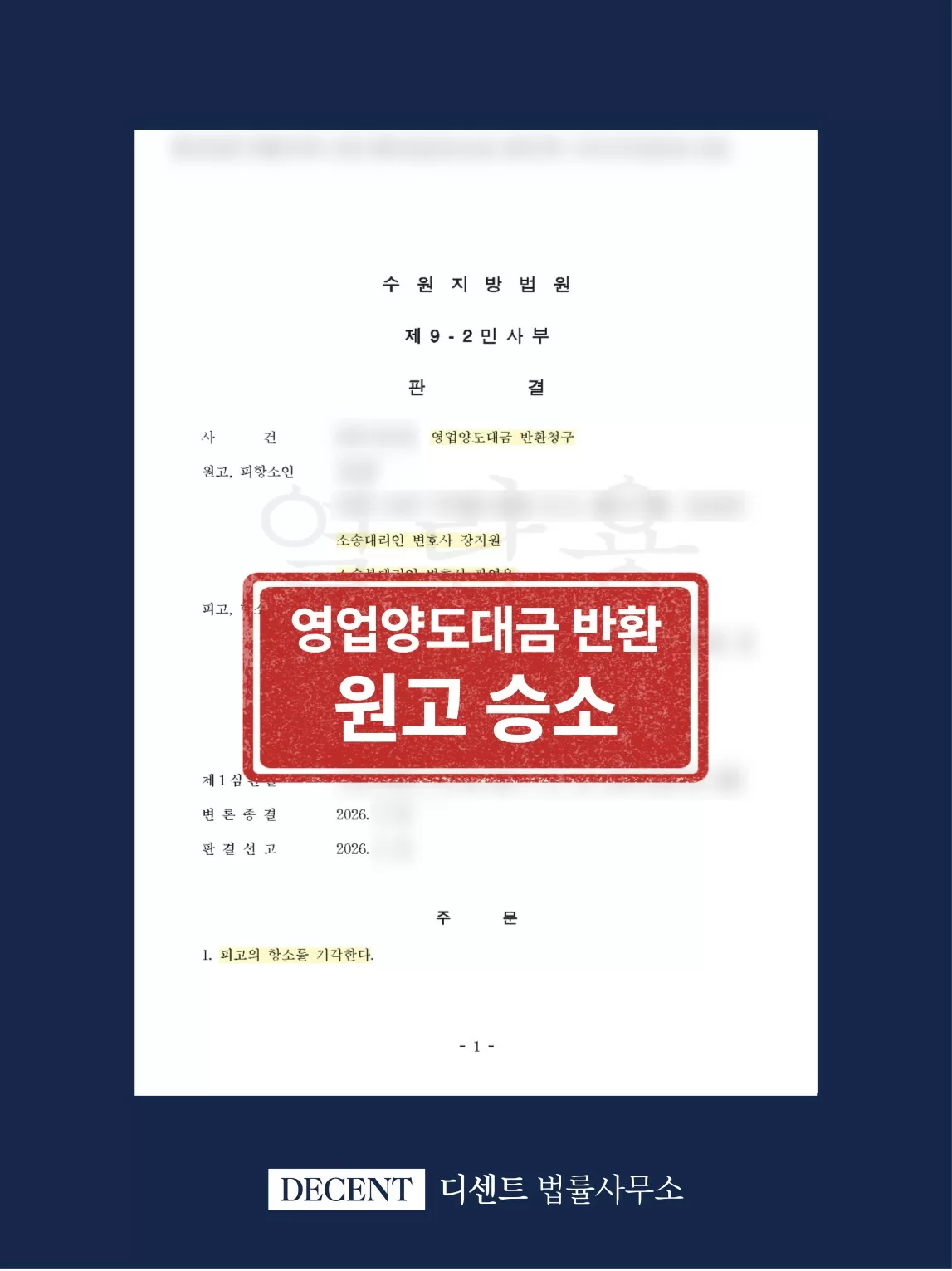
The court found that the business transfer agreement had been validly rescinded due to the seller’s delay in performance.
The court recognized that the seller’s failure to complete the name transfer and clear the provisional attachment constituted non-performance after the due date.
The court also held that the client’s KakaoTalk notice was a valid demand for performance and rescission notice.
As a result, the seller was ordered to return the transfer payment, excluding KRW 8,000,000 in inventory costs that had been used during the restaurant’s operation. The court awarded KRW 72,903,931 plus annual interest of 6%.
Legal Consultation
All consultations are conducted after a case review by the attorney in charge.
Providing the key details of your case in advance will help you receive more specific advice.