

Non-Prosecution Decision in a Medical Device Advertising Case
Case Overview
- Client Information
- Corporate / Suspect
- Case Details
-
The client was a company manufacturing and selling medical devices in Korea. During its product promotion activities, certain advertising expressions were alleged to constitute prohibited advertising under the Korean Medical Devices Act.
The issue arose from statements that could be interpreted as suggesting that doctors or other professionals had endorsed or recommended the performance or effectiveness of the medical device.
Multiple promotional materials were reviewed, including leaflets, blog posts, Naver Place information, and Instagram posts. The matter eventually led not only to administrative proceedings but also to a criminal complaint.
Although the client had already removed or discarded potentially problematic advertising materials after receiving administrative guidance, the criminal investigation continued. The client therefore retained Decent Law Firm to develop a structured defense strategy.
Decent's Strategy
Under the Korean Medical Devices Act, false or exaggerated advertising regarding the performance, efficacy, or effects of a medical device is prohibited. Advertising that may mislead consumers into believing that a doctor or expert has guaranteed, recommended, or endorsed a medical device is also restricted.
The Enforcement Rule of the Medical Devices Act further specifies the scope of prohibited advertising. Therefore, in an actual criminal case, it is essential to examine which legal provision applies and whether the specific elements of that provision are satisfied.
1. Separating Advertising Expressions from Legal Elements
Decent reviewed whether the disputed expressions merely had the potential to mislead consumers, or whether they actually fell within a category of prohibited advertising subject to criminal punishment under the Medical Devices Act.
In particular, Decent distinguished between general promotional language used in a leaflet or marketing material and the specific type of prohibited advertising contemplated by the applicable legal provision.
2. Demonstrating Prior Corrective Measures
After the first on-site inspection, the client promptly removed the website advertisement in accordance with administrative guidance.
The client also conducted an internal review and voluntarily removed or discarded other materials that could raise legal concerns, including leaflets, blog posts, and Naver Post content.
Decent organized the timeline and details of these corrective measures to show that the client had not neglected the issue, but had taken active steps to resolve it once the risk was identified.
3. Explaining the Absence of Intentional Misconduct
Decent emphasized that the client had not intentionally violated the Medical Devices Act. Rather, the issue arose from a lack of detailed understanding of medical device advertising regulations.
Expressions related to product performance, intended use, professional expertise, or medical personnel may appear natural from a general marketing perspective. However, under Korean medical device regulations, such expressions require careful legal review.
4. Submitting Materials on Recurrence Prevention
Decent also supplemented the defense with materials showing the client’s efforts to prevent recurrence.
The client entered into a legal advisory agreement to establish a prior review system for advertising materials, conducted internal training on the Medical Devices Act and advertising regulations, appointed a person in charge of medical device advertising compliance, and built an internal monitoring system for external promotional materials such as websites, social media, and leaflets.
Through these materials, Decent demonstrated that the client was not merely seeking to avoid punishment, but had improved its internal compliance system to ensure future regulatory compliance.
Source: Korea Law Information Center, Article 24 of the Medical Devices Act and Article 45 of the Enforcement Rule of the Medical Devices Act
Results & Significance
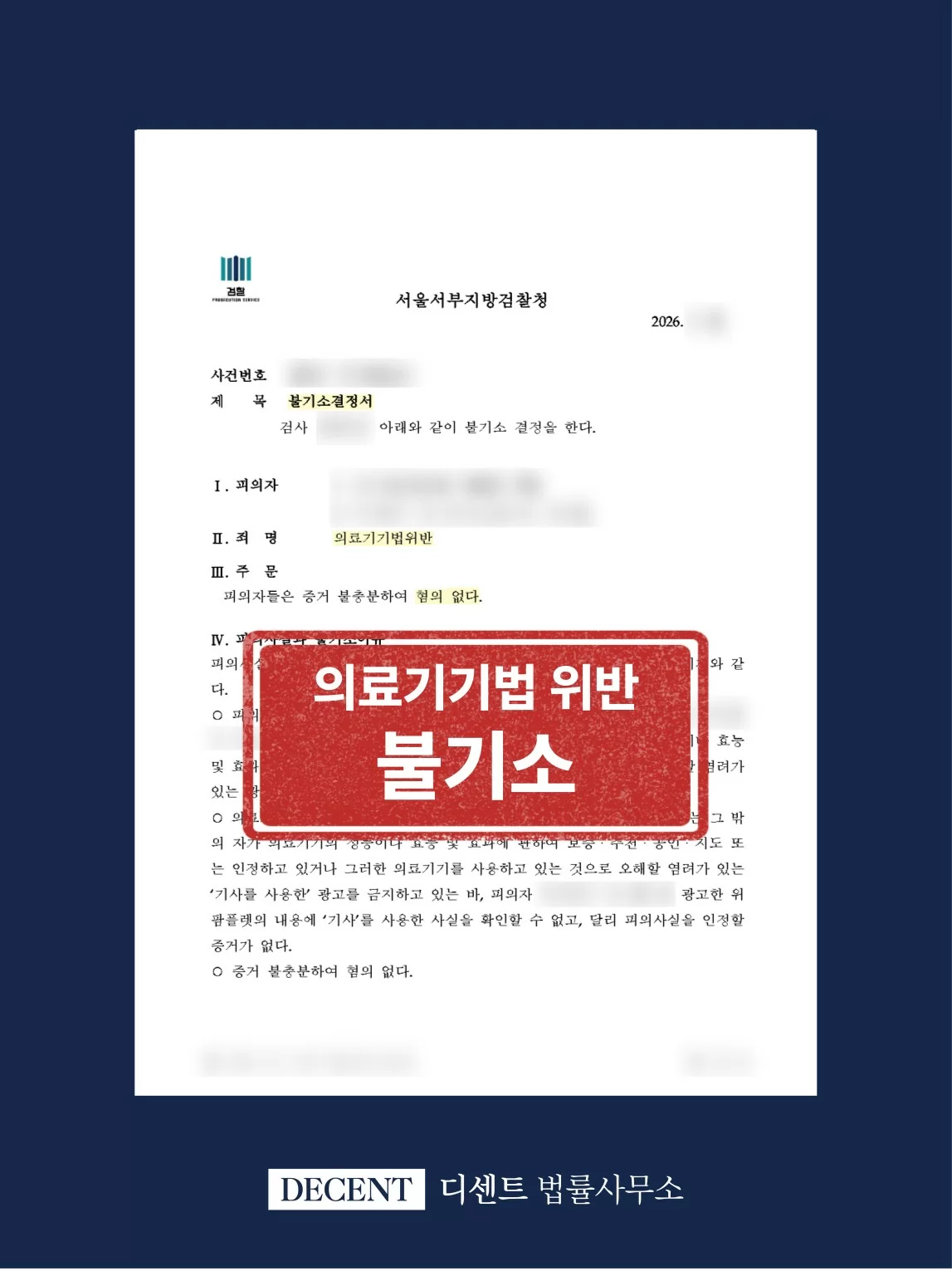
The prosecution ultimately issued a non-prosecution decision in favor of both the client and the client company.
The key issue was not simply whether the advertising expressions were appropriate, but whether the disputed materials actually fell within a legally punishable category of prohibited advertising under the Medical Devices Act.
The prosecution reviewed the fact that the promotional materials included expressions that could potentially mislead consumers. However, it found that the evidence was insufficient to establish that the expressions satisfied the legal elements required under the applicable provision.
During the investigation, Decent distinguished the disputed advertising expressions from the statutory requirements of the relevant legal provision, while also presenting the client’s prior corrective measures and recurrence prevention efforts.
As a result, the client and the client company received a non-prosecution decision on the alleged violation of the Medical Devices Act.
Legal Consultation
All consultations are conducted after a case review by the attorney in charge.
Providing the key details of your case in advance will help you receive more specific advice.