

If You Were Reported for Fraud While Running a Crypto Referral — A Real Case of Non-Referral Decision
Case Overview
- Client Information
- Individual / Suspect
- Case Details
-
Our client worked at a cryptocurrency-related company, providing coin futures trading information to customers. When a complainant suffered forced liquidation after independently maintaining a high-leverage position, the client was reported to police on charges of fraud.
The complainant alleged that our client had induced investment by implying guaranteed returns, and had concealed referral commission income earned through a crypto referral (exchange referral code) arrangement.
DECENT's Virtual Asset Practice Team accompanied the client during police questioning from day one, and submitted two separate written defense opinions — arguing the absence of fraudulent intent and the lack of causal connection between our client's conduct and the complainant's losses. The police ultimately issued a non-referral decision on grounds of insufficient evidence.
Decent's Strategy
Statements made in the early stages of an investigation form the foundation for all subsequent judgments. DECENT's Virtual Asset Practice Team attended the suspect interview on the very first day of police questioning, ensuring our client could present the facts accurately and consistently.
2. Disproving Fraudulent Intent — First Written Defense Opinion
Our client was simply an information provider relaying analysis from in-house experts — no guarantees of profit or principal protection were ever made. We substantiated the absence of fraudulent intent through chat records showing repeated risk disclosures, as well as evidence that the complainant voluntarily continued investing during periods of profit.
3. Arguing Absence of Causal Connection — Second Written Defense Opinion
The forced liquidation occurred in a high-leverage cross-margin position that the complainant maintained independently, without any direction from our client. We confirmed through trading records that the complainant voluntarily resumed trading even after the liquidation — establishing that the losses stemmed from the complainant's own investment decisions, not our client's conduct.
4. Rebutting the Referral Commission Allegation
Regarding the complainant's claim that referral commissions were concealed: we clarified that crypto referral commissions are calculated based on trading volume, entirely independent of whether the referred user profits or loses. Our client had no structural incentive to cause the complainant's losses — and had in fact explained the referral structure to the complainant directly.
Results & Significance
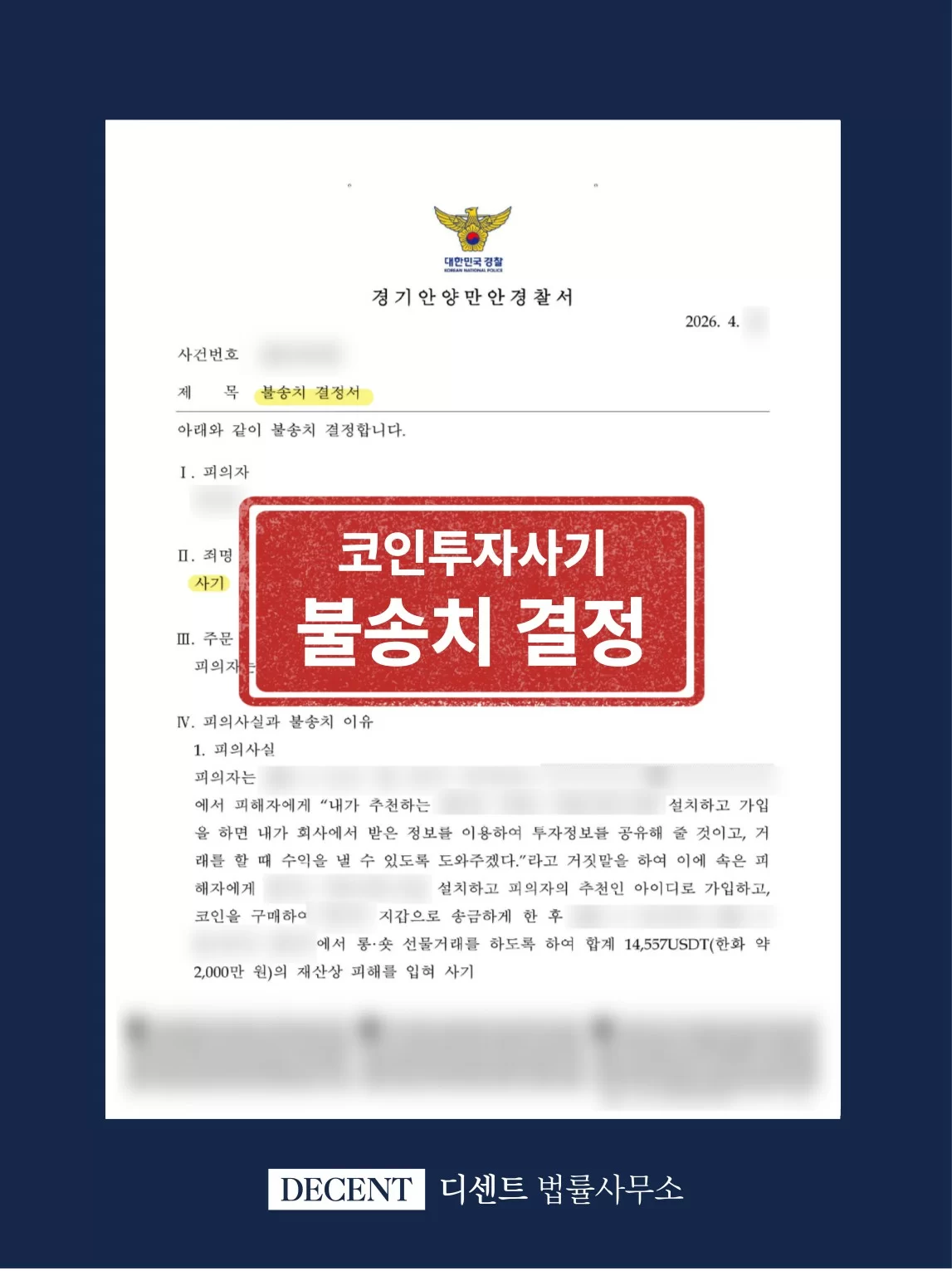
The police issued a non-referral decision for our client on grounds of insufficient evidence.
The decision explicitly confirmed the following:
▪️ Our client never promised guaranteed returns or guaranteed profits, and had in fact disclosed the possibility of losses.
▪️ Given the structure of the referral commission, our client had no motive to cause the complainant's losses.
▪️ The complainant's forced liquidation arose from an independently maintained position unrelated to our client's guidance, making it difficult to establish a causal link between our client's conduct and the complainant's losses.
The investigating authority's final determination was that providing investment information alone is insufficient to establish the fraudulent intent or causal connection required for a fraud conviction under Korean criminal law.
Legal Consultation
All consultations are conducted after a case review by the attorney in charge.
Providing the key details of your case in advance will help you receive more specific advice.
LAWYERS
-
 MP
Hyeonsu “Elliot” Jin
#Cross-border · Dispute Resolution #Crypto #VC · Financial Advisory #IP Litigation #Sports
-
 MP
Pureun “Ian” Hong
#Criminal #Class Action #Crypto #Real Estate Disputes · Construction #Entertainment
-
 A
Dayoun “Diane” Lee
#Criminal #Civil #Crypto #Corporate & Biz #Cross-border · Dispute Resolution #VC · Financial Advisory


