

Regulatory Review of an Overseas Crypto Exchange Referral Business: Whether VASP Registration Was Required in Korea
Case Overview
- Client Information
- Corporate / Business Entity
- Case Details
-
The client was operating a referral-based business involving an overseas virtual asset exchange.
Under the business model, the client published and promoted a referral code issued by the overseas exchange through its own website, blog, YouTube channel, and other online channels. When users signed up for the exchange using the referral code and conducted transactions, the client received referral fees from the exchange as marketing or advertising compensation.
The client requested a comprehensive legal review on whether this business structure could fall within the definition of a virtual asset service provider under Korea’s Act on the Protection of Virtual Asset Users, thereby triggering a reporting obligation under the Act on Reporting and Using Specified Financial Transaction Information.
The client also sought practical guidance on content wording, advertising practices, and the management of external collaborators such as bloggers and influencers.
Decent's Strategy
Article 2, Subparagraph 2 of the Act on the Protection of Virtual Asset Users defines a virtual asset service provider as a person who, as a business, engages in the sale, purchase, exchange, transfer, custody, management, brokerage, arrangement, or agency of virtual asset transactions.
The reporting obligation under the Act on Reporting and Using Specified Financial Transaction Information is closely connected to whether a business falls within this definition.
The Supreme Court of Korea has held that whether a business constitutes a virtual asset service provider should be determined reasonably in light of social norms, based on a comprehensive review of the purpose, type, scale, frequency, duration, and manner of the relevant virtual asset transactions. See Supreme Court Decision 2024Do10710, rendered on December 12, 2024.
DECENT reviewed the client’s business model and confirmed the following key points:
▪️ No custody or control of user assets
The client did not directly hold, manage, or control users’ virtual assets or fiat currency.
▪️ No involvement in the transaction process
The client did not participate in selecting counterparties, forming transaction terms, or executing orders.
▪️ Independent decision-making by users
The final decision on whether to use the exchange and under what conditions to trade remained entirely with the users.
2. Review of Content Wording and Operational Risk Management
DECENT also reviewed the fact that, separate from the business structure itself, the legal characterization of the referral business could change depending on how it was actually operated.
▪️ Permissible scope of information provision
Providing objective information about the exchange, such as its service structure and fee system, may be viewed as a relatively low-risk activity.
▪️ High-risk expressions
Content emphasizing high-leverage trading, futures trading, KRW deposit or withdrawal options, or potential profits may be viewed as investment solicitation or transaction arrangement, depending on the specific wording and context.
▪️ Management of collaborator structure
In a multi-layered structure involving a referral operator, marketing agency, bloggers, and influencers, DECENT advised that the roles and responsibilities of each party should be clearly defined and consistently reflected in both the contracts and actual operations.
▪️ Risk related to unregistered overseas exchanges
If the referred overseas exchange targets Korean users without completing the required registration in Korea, the legal assessment of promoting or arranging access to that exchange may raise separate regulatory concerns.
Results & Significance
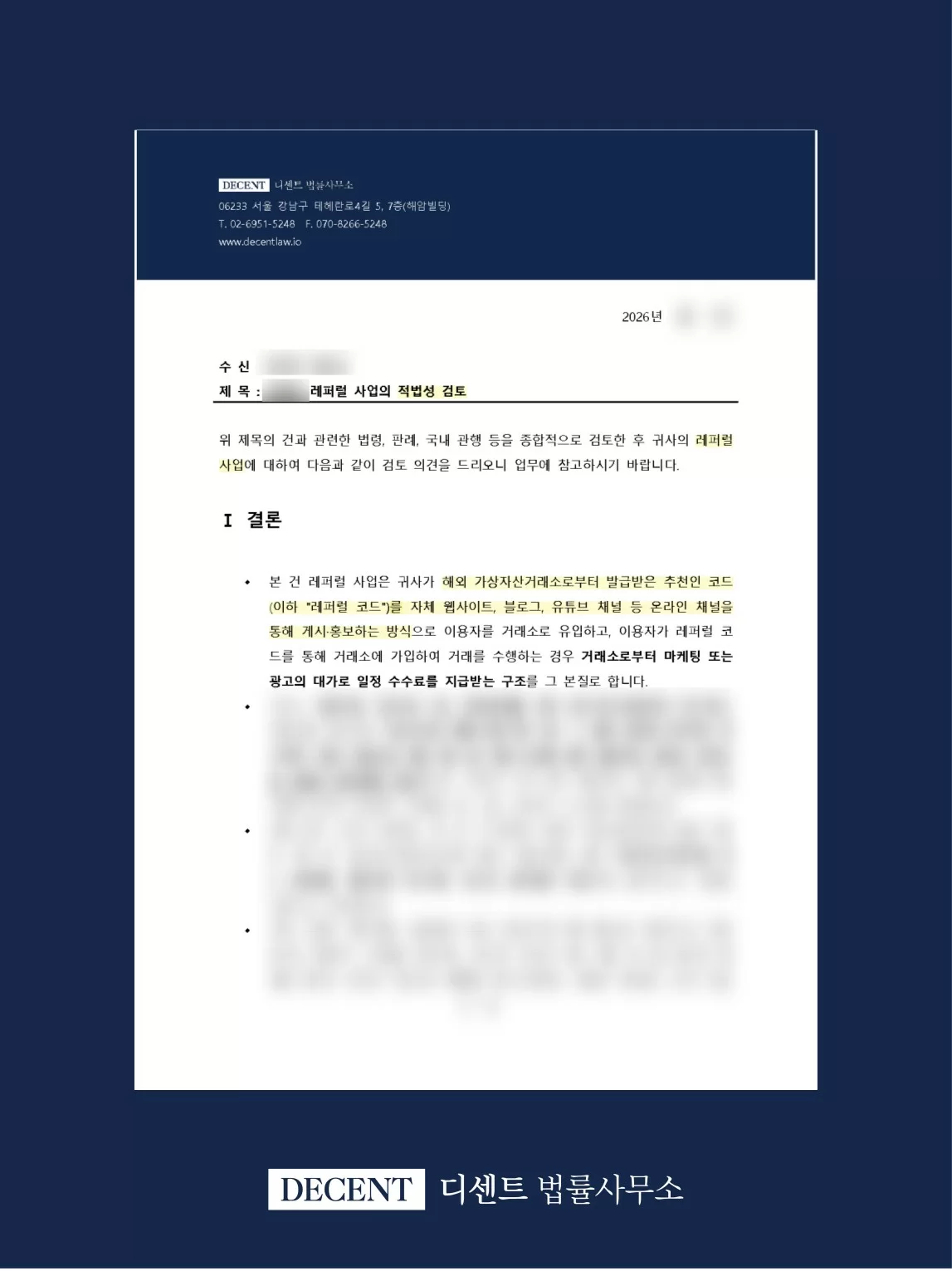
DECENT concluded that, based on the assumption that the client’s referral business did not involve any substantive participation in users’ transaction execution and remained limited to introducing the exchange and providing objective information, the business was unlikely to fall within the definition of a virtual asset service provider under the Act on the Protection of Virtual Asset Users.
Accordingly, the business was also unlikely to be subject to the virtual asset service provider reporting requirement under the Act on Reporting and Using Specified Financial Transaction Information.
DECENT also provided practical guidelines on content wording, advertising practices, collaborator management, and regulatory risk control for the client’s ongoing operation of the referral business.
Legal Consultation
All consultations are conducted after a case review by the attorney in charge.
Providing the key details of your case in advance will help you receive more specific advice.